 SGD
 EUR
 AUD
 GBP
 JPY
 INR
Total: $0.00
Taxes and shipping calculated at checkout


The space changes the meaning: in standard English, myself is one word, used reflexively when the speaker both performs and receives an action, or emphatically when they personally do something. The two-word phrase my self belongs in philosophical writing about identity or the self as a concept.
It’s easy to see why the distinction causes hesitation: both forms look similar, and myself can sound polished in a sentence. But it has a specific grammatical role, so it doesn’t replace me in standard English. Use me as an object when an action affects you, and choose myself only when it refers back to I or adds emphasis. This guide explains these patterns with clear examples, shows where the word can appear in a sentence, and distinguishes standard usage from informal constructions. By the end, you’ll know when the single word is precise, when the two-word form makes sense, and how to choose the natural pronoun without second-guessing.
A reflexive pronoun refers back to the sentence’s subject. In “I taught myself to sew,” the subject and learner are the same person. English reflexive pronouns end in -self or -selves. Related forms include yourself, herself, and ourselves. Match the pronoun to its subject: “They prepared themselves” works because both words refer to the same people. “They prepared herself” breaks that connection. A reflexive form doesn’t introduce a different person or replace a regular object pronoun.
In reflexive use, the subject receives its own action. As a direct object, the pronoun follows the verb: “I blamed myself.” As an indirect object, it identifies the recipient, usually before another object: “I made myself a cup of tea.” The cup is the direct object; the speaker receives it. After a preposition, the pronoun acts as that preposition’s object: “She spoke to herself.” These examples show how the same form works in different sentence positions.
Position depends on the grammatical role, not simply on sentence length. Place a direct object after its verb, as in “He introduced himself.” Put an indirect object before the thing received, as in “She bought herself a notebook.” Put the reflexive pronoun after its preposition, as in “He kept the note for himself.” After a linking verb, it can describe the subject: “After the costume change, I was myself again.” In each sentence, trace the pronoun back to its subject.
Using a reflexive pronoun for politeness means choosing it instead of a personal pronoun. Some speakers say, “Please send the document to myself,” to sound formal. But politeness doesn’t make this use reflexive, because “I” isn’t the sentence’s subject. In careful standard English, write, “Please send the document to me.” A reflexive pronoun also can’t stand alone as the subject: “My colleague and I attended” is standard, not “My colleague and myself attended.” Check the subject first, then choose the matching form.
An emphatic pronoun adds stress to a person already named in the sentence. In “I, myself, chose the silver frames,” the extra pronoun highlights “I.” The core statement remains “I chose the silver frames.” Remove the emphasis, and the basic meaning stays intact. This optional use differs from reflexive grammar, where the pronoun completes the action or refers back to its subject.
English allows emphatic placement in several positions. At the sentence’s end, “I arranged the display myself” stresses personal involvement. After the subject, “I myself arranged the display” gives the speaker immediate focus. “I arranged myself the display” changes the grammar and sounds unnatural for this meaning. Keep the subject and verb clear, then place the emphasis where it reads smoothly.
Use the same pattern with other pronouns: “The stylist herself selected the frame” emphasizes the stylist, while “They themselves chose the design” stresses the group. The emphatic form must match its subject: “he himself,” “we ourselves,” and “you yourself.” These additions don’t create a new subject or object. They spotlight one already present, like a verbal underline rather than a required sentence part.
To test an emphatic use, remove the added pronoun and reread the sentence. “I checked the details myself” still works as “I checked the details.” The first version stresses that the speaker personally did it. If removing the pronoun leaves an incomplete idea, it may have another grammatical role. Compare “I introduced myself” with “I introduced the speaker myself.” In the first, the pronoun completes the action; in the second, it highlights who introduced the speaker. This quick edit helps distinguish emphasis from necessary grammar.
A personal pronoun names the speaker without referring back to a subject. Use “me” as an object, as in “Please invite me.” Use “I” as a subject, as in “I will attend.” The reflexive form is not a more formal replacement for either one. In standard English, its role depends on a matching subject or a clear emphatic purpose.
In compound subjects, people sometimes choose the reflexive form to sound formal or tactful. For example, “My colleague and myself will attend” appears in informal speech and personal writing. In careful standard English, write, “My colleague and I will attend.” Remove the other person’s name to test the grammar: “Myself will attend” is not the standard subject construction. “I will attend” keeps the subject pronoun clear.
Compound objects create a similar trap. A speaker might say, “The manager spoke with my colleague and myself.” Here, both people are objects of “with,” so use “me”: “The manager spoke with my colleague and me.” Test the phrase by removing “my colleague.” “The manager spoke with me” sounds natural. “The manager spoke with myself” wrongly uses a reflexive form without a matching subject.
These substitutions are common in casual speech and personal writing, but less common in formal contexts. Using the reflexive form as a single subject is rare outside poetic or literary writing. Using it as a simple object is also uncommon. Some constructions after “as,” “than,” or “but” can use the form in speech and writing, such as “Nobody but myself noticed.” For polished prose, “Nobody but me noticed” is clearer. In British English, compound phrases using the reflexive instead of “I” or “me” are labelled nonstandard. For work emails, reports, and applications, identify whether the pronoun is a subject or object, then choose “I” or “me.”
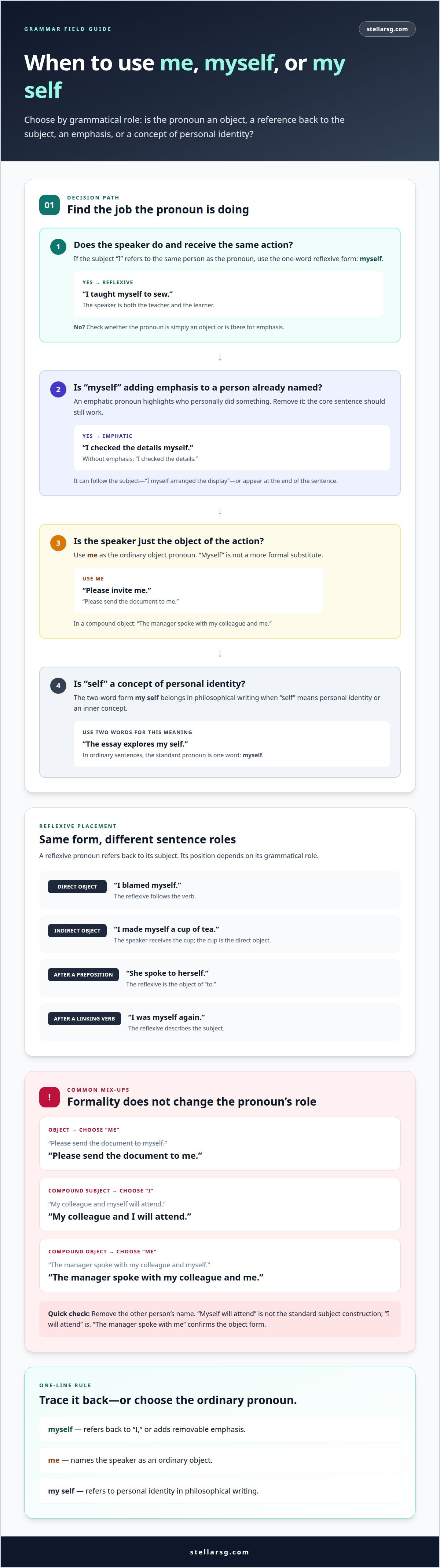
The standard reflexive pronoun is one word: myself. In most standard English writing, this spelling expresses a reflexive or emphatic meaning. Choose the single word when the speaker refers back to “I,” as in “I reminded myself to call.” The two-word form, “my self,” is different. It can appear in philosophical writing when “self” means personal identity or an inner concept, as in “The essay explores my self.” In ordinary sentences, use the one-word spelling.
“By myself” means alone or without help from anyone else. In “I travelled by myself,” the phrase describes travelling alone. In “I assembled the shelf by myself,” it stresses that the speaker worked without assistance. The surrounding verb helps clarify which meaning fits. Neither example means the subject and object are separate people: the phrase describes how the action happened.
“To myself” can mean reserved for my own use. For example, “I kept the final slice to myself” means the speaker kept it rather than sharing it. The phrase can also describe something said privately: “I whispered the answer to myself.” Read the complete sentence to identify whether it signals private speech or personal use.
In British English, “not be myself” or “not feel myself” can describe feeling less happy or healthy than usual. “I haven’t felt myself today” means the speaker feels unlike their usual self. Context gives the meaning: “I spoke to myself” describes an action, while “I don’t feel myself” describes a state. The expression “feel myself” can also mean “feel good,” so the surrounding words matter.
For a quick spelling check, decide whether “self” refers to identity as an idea. If not, write the pronoun as one word. Then check the subject and object: “I prepared myself” links both to the speaker. This simple edit helps keep spelling and meaning aligned.
Stellar SG offers professional ear piercing for those considering an alternative to piercing their ears themselves. Its Piercing Service is complimentary with the purchase of piercing studs and uses a hand-pressure instrument and single-use needles. If you’re weighing the procedure, you can consider a professional service rather than attempting it alone. Stellar SG also offers jewelry, so you can explore earrings alongside your piercing plans.
Choose the next step that suits you: learn about the ear piercing service or arrange an appointment. If you’re still deciding, take time to consider your comfort and the look you want. An appointment gives you a practical starting point for discussing your ear-piercing plans.
Contact Stellar SG to discuss an ear-piercing appointment.
Clear choices in language come from noticing what a sentence needs. The same thoughtful approach helps when considering a personal style decision: pause, consider what feels right, and choose a next step that suits you. You don’t need to rush into a decision to make it confidently.
If ear piercing is the decision on your mind, Stellar SG offers a Piercing Service and jewelry. You can explore those options as you consider the look you’d like and whether a professional service feels right for you. Let your preference guide the conversation, rather than pressure or uncertainty.
For a personal discussion about ear piercing, contact Stellar SG for expert advice. Take the next step when you feel ready, and make it your own.
Myself is a one-word pronoun; my self is a two-word phrase about identity. In “I introduced myself to the host,” the word is a pronoun. In “The poem explores my self,” the writer treats identity as an idea. For ordinary sentences, use the single-word form. Choose the spaced form only when discussing the self as a concept.
In English, the word refers to the speaker or writer, either reflexively or emphatically. “I reminded myself to call” links it to the subject. “I prepared the presentation myself” stresses personal effort. The phrase around it can also shape the meaning: “by myself” can mean alone, while “to myself” may suggest privacy or personal use.
Use it when the subject and the person affected by the action are the same. For example, “I taught myself to play chess” means the speaker learned without another person teaching them. First identify who performs the verb. Then ask whether the action refers back to that person. If someone else receives the action, name that person instead.
“I” acts as a subject; “myself” refers back to that subject or gives it emphasis. Compare “I chose the layout” with “I chose the layout myself.” The second stresses who made the choice. In standard English, use “I” before a verb as the subject. For instance, write “My friend and I agreed,” not “My friend and myself agreed.”
Use it when an action refers back to the speaker, as in “I reminded myself about the meeting.” It can also add emphasis: “I wrote the note myself.” In that emphatic example, removing the word leaves a complete sentence. Check whether it has a clear role before including it. If it simply stands in for “me” or “I,” choose the personal pronoun instead.
One common error is using the reflexive form to sound formal: “Please send the draft to Priya and myself.” In standard usage, write “Priya and me.” Another is using it as a subject, as in “Myself and Priya reviewed the draft.” Write “Priya and I reviewed the draft.” Test a compound phrase by removing the other person’s name.


