 SGD
SGD EUR
EUR
 AUD
AUD
 GBP
GBP
 JPY
JPY
 INR
INR
Total: $0.00
Taxes and shipping calculated at checkout


The prettiest jewelry end isn’t the only detail that matters. With threadless vs threaded piercing jewelry, the fastening affects how the end connects to the post, how you handle it, and what to check before changing it. The terms can sound technical, especially because “threaded” can refer to different designs.
If you’re unsure which option suits your piercing or daily routine, you’re not alone. Neither fastening style is automatically right for everyone, and appearance alone won’t tell you how a piece works. This guide explains how threadless jewelry uses a tension-fit pin, while internally threaded jewelry screws into the post. It also compares everyday handling and compatibility.
Fastening style is only one part of choosing jewelry. Material, fit, and suitability for your piercing matter too. By the end, you’ll know what to ask a professional before selecting or changing a piece, so you can make a considered choice.
Threadless jewelry connects a removable end to a hollow post with a tension-fit pin, while threaded jewelry connects its end to the post by screwing the components together. In both cases, the terms describe the fastening mechanism, not the jewelry material. A post and decorative end can be made from different materials, so check material and suitability separately from closure type.
That distinction makes threadless vs threaded piercing jewelry easier to compare, but it doesn’t identify the right piece for every piercing. Fit, jewelry design, placement, compatible components, and guidance from a qualified professional all matter. A fastening style that works for one person may not be the best match for another.
A threadless piece has a hollow post and a removable decorative end with a small pin. The pin is gently adjusted to create tension, then inserted into the post. That tension holds the end in place. The post and end need to be compatible, and the pin must be adjusted appropriately. Don’t assume parts will fit just because they look alike.
This system has no screw threads joining the two pieces. That describes how it fastens, not a guarantee that it will be more secure, comfortable, or suitable for every placement. If you’re unsure whether the end and post match, ask a professional before changing them.
Threaded jewelry joins a decorative end to a post using matching screw threads. With internally threaded jewelry, the post has a hollow opening with threads inside, and the end has a threaded pin that screws into it. With externally threaded jewelry, the threads sit on the outside of the post, and the end screws onto them. These are different constructions, not interchangeable terms.
The Association of Professional Piercers’ guidance for initial piercings accepts internally threaded or threadless jewelry, rather than externally threaded jewelry. For a visual reference to the construction of internally threaded barbells, compare how the end and post connect. Before purchasing, confirm that the components match. Threaded parts can vary in compatibility, so a similar appearance isn’t enough.
Whichever closure you’re considering, ask about post dimensions and fit as well as fastening. If you’re uncertain about an existing piece or a change, an in-person conversation with a piercing professional can help you identify what you have and what to ask next.
The practical difference shows up when fitting or changing the end. Threadless jewelry requires you to align a small pin with the post opening and press the parts together. Threaded jewelry requires you to line up matching threads and screw the end into or onto its post. The Association of Professional Piercers describes these fastening types in its guidance on jewelry for initial piercings.
| Consideration | Threadless | Threaded |
|---|---|---|
| Connection | A pin on the end fits into a hollow post and stays in place through tension. | A threaded end screws into an internally threaded post, or onto an externally threaded post. |
| Component matching | The end and post must be designed to fit together. Similar-looking pieces may not be compatible. | The end and post need matching thread type and sizing. Compatibility can vary between pieces. |
| Handling | Align and press the end into the post. Correct adjustment and a steady grip matter. | Align the threads, then turn the end to fasten it. Small components can be challenging to handle. |
In short, fastening describes how the end joins the post. Material and fit are separate considerations. The closure is only one part of a jewelry change. You also need the right post dimensions and a piece suitable for the piercing and its current condition. If the piercing is still healing, ask a qualified professional before changing jewelry rather than treating fastening style as the only factor.
Ease depends on your hands, the piercing’s location, and the jewelry’s dimensions. A threadless end needs careful alignment and a controlled push. A threaded end needs alignment and turning, which can be awkward if the area is hard to see or reach. Neither action is effortless for everyone. If you can’t hold the jewelry securely or aren’t sure how it fits, pause and seek professional help.
There isn’t a universal answer based on closure type alone. A suitable post and end, correctly matched and assembled, are central to a secure fit. If a piece feels loose, is difficult to fasten, or you’re concerned about how it sits, don’t guess or force it. Ask a qualified piercer to assess that specific jewelry and placement.
If you’re uncertain about an ear piercing or jewelry fit, an in-person conversation can help clarify what to check. Learn more about Stellar’s ear-piercing service.
There’s no single fastening style that suits every wearer. Choose based on how you handle jewelry, whether the parts are compatible, and how the piece fits your piercing. Design and location matter too: a small end in a hard-to-reach spot may be trickier to manage than a larger, easier-to-grip design. A professional can help assess whether a particular piece is appropriate for your piercing.
Use this comparison as a starting point, not a universal ranking. In the threadless vs threaded piercing jewelry decision, the best option is the one that fits your needs and can be correctly matched and handled.
| Consideration | Threadless may suit you if… | Threaded may suit you if… |
|---|---|---|
| Everyday handling | You prefer joining the end and post with a push-fit connection. | You’re comfortable aligning and turning the end to connect it. |
| Replacement parts | You can confirm the replacement end matches the post. | You can confirm the end and post have compatible threading. |
| Design and placement | The piece’s shape and access make the connection manageable for you. | You can comfortably handle the screw connection at that location. |
| Professional input | A professional confirms the piece is a suitable match for your piercing. | A professional confirms the post, end, and fit are appropriate. |
Consider threadless jewelry if you prefer a push-fit connection and can manage the end comfortably. Before buying a replacement end, confirm that it’s designed to work with your post. A matching appearance doesn’t establish compatibility. Placement, jewelry dimensions, and professional assessment still matter, especially if the area is difficult to reach or you’re unsure about fit.
Threaded jewelry may appeal if you prefer a screw-connected end and know how to assemble it without forcing the parts. Check that the post and end have compatible threading before purchasing. A threaded connection alone doesn’t make a piece safer or more durable. If the parts don’t align easily or you’re uncertain about fit, pause and ask a professional.
Keep closure and material decisions separate. Once you’ve considered handling and compatibility, assess whether the jewelry material suits your needs. For more on that choice, read Stellar’s guide to piercing jewelry metals. If you’re still unsure about a piece or its placement, ask a qualified professional before changing it.
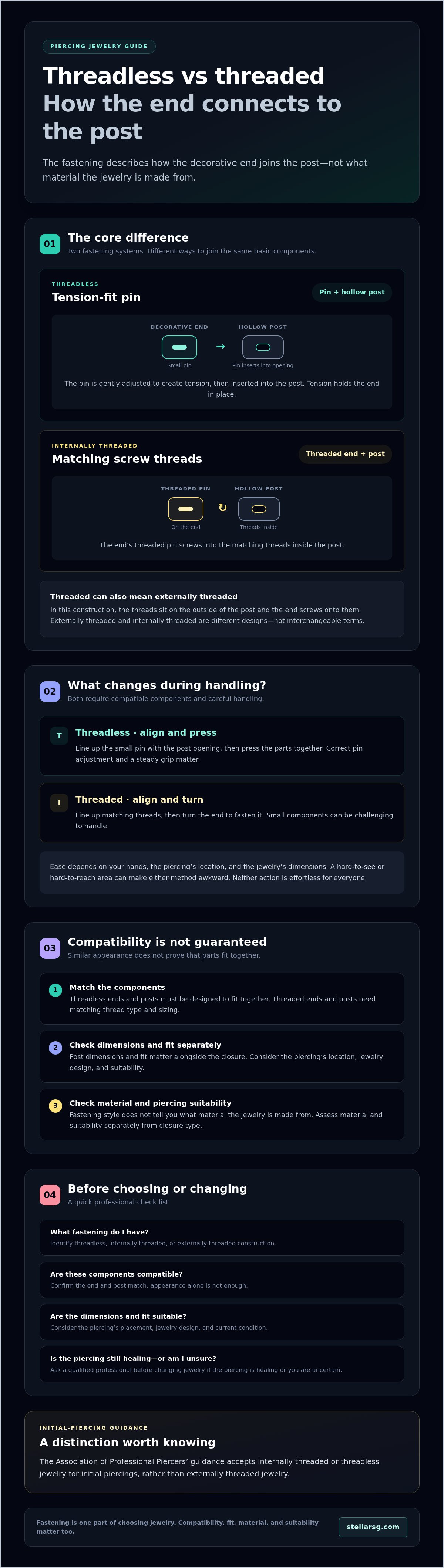
Before changing a piece, check more than whether it’s threadless or threaded. Post dimensions, piercing location, and jewelry design all affect fit and handling. Use this short sequence to keep the checks clear:
Fit matters independently of closure. A post that’s too short or long for the placement may not sit as intended, while the wrong end may not connect properly. Don’t force a component that resists, and don’t assume a different fastening style will fix a fit issue. Follow the aftercare guidance provided by your piercing professional, especially if you’re unsure whether a change is appropriate.
Ask a professional to confirm the post dimensions and which end fits it. Share where the piercing is and, if possible, show the existing jewelry or its product details. Check the material information separately from whether the piece is threadless or threaded. The design should suit the placement and your piercing’s current needs, not just the look you want.
Seek professional guidance if you can’t identify the closure, can’t manage the connection, or aren’t sure the piece is suitable. Stop if the jewelry resists, causes pain, or appears incompatible. Don’t twist, push, or pull harder to make it fit. A professional can assess the specific jewelry and advise on next steps rather than guessing from appearance alone.
If you’d like professional guidance, learn about Stellar’s ear-piercing service.
Choosing between threadless vs threaded piercing jewelry involves more than deciding which connection seems easier. Consider how you'll handle the fastening and whether its components match, then check post fit, jewelry material, and whether the design suits your piercing. If any detail is unclear, professional guidance can help you make a considered choice instead of relying on appearance alone.
Stellar SG offers professional ear-piercing services and a curated range of jewelry at retail locations in Singapore. Fastening styles and specifications may vary, so ask in person about the piece you're considering rather than assuming a particular closure is available. Sharing your piercing location and preferred fastening style can make the conversation more useful.
Bring the questions that matter to your decision. A clear conversation can help you distinguish closure preference from fit and material suitability:
Check these details together. A compatible closure won't resolve a post that doesn't fit, and material should be assessed separately from fastening. If a piece resists or you're uncertain about changing it, pause and seek professional advice instead of forcing the connection.
An in-person conversation can help you explain your preferences, discuss your ear piercing, and ask questions about the jewelry you're considering. Stellar SG's Singapore locations offer professional ear piercing and curated jewelry, but available fastening styles and specifications can vary. Check current visit information before you go, and ask about your preferred style directly.
For appointment information, visit Stellar SG's booking page and bring your questions along.
The key to comparing threadless vs threaded piercing jewelry is understanding how each end connects, then considering how you’ll handle it and whether its components match. Neither fastening style is automatically right for every wearer. Fit, placement, design, and material each deserve separate attention.
If you’re unsure what closure your jewelry uses, whether a replacement end is compatible, or whether a piece fits your piercing, don’t force a change. Ask a professional for guidance. Stellar offers professional ear-piercing services and curated jewelry at physical locations in Singapore, where you can ask about your piercing and preferred fastening style. Check which jewelry specifications are available at the location before making a selection.
To discuss your piercing and jewelry preferences in person, book an appointment with Stellar.
Threadless jewelry has a removable end that fits into a post, while threaded jewelry connects its end to a matching post with screw threads. These terms describe how the pieces fasten, not the material or overall quality. When comparing threadless vs threaded piercing jewelry, check that the components are compatible and the post fits your piercing. If you’re unsure about a specific piece, ask a professional piercer to confirm.
Neither fastening system is universally safer in every situation. Suitability depends on factors such as appropriate fit, compatible components, suitable material, and correct handling. Ask a qualified piercer about the specific jewelry and placement you’re considering rather than judging by closure type alone. If a piece feels stuck, causes pain, or seems incompatible, don’t force it. Stop and seek professional assistance.
You may or may not be able to manage a change yourself. It depends on the piercing’s placement and healing status, the jewelry’s fit, and your confidence handling its components. Don’t treat the fastening type alone as a reason to change jewelry without help. If you’re unsure about compatibility or what your piercing needs, ask a professional piercer. Avoid forcing the end or post if the connection doesn’t feel right.
Threaded jewelry is removed by unscrewing the end from its matching post, but the exact construction can vary. Follow instructions from a professional for your specific piece instead of assuming a direction or method. If the end resists, causes discomfort, or appears damaged, stop rather than applying force. A qualified piercer can assess the jewelry and help you determine an appropriate next step.
No, don’t assume threadless and threaded components are interchangeable. They connect in different ways, so an end designed for one closure may not fit a post designed for the other. Confirm compatibility for the exact post and end before buying a replacement or attempting a change. A piercer or the jewelry seller can check the components. Similar appearance isn’t proof that two parts will connect properly.
There isn’t one best choice based on closure type alone. For a new piercing, suitability depends on placement, jewelry fit and material, and a professional’s recommendation. Ask your piercer which specific piece is appropriate for your circumstances, including its dimensions and fastening. Don’t choose or change jewelry solely because one system sounds easier or looks preferable in a general comparison.
Threadless jewelry’s everyday fit depends on correctly matched components, suitable dimensions, and proper assembly. No fastening style should be treated as a guarantee of security for every piece or wearer. If the jewelry feels loose or shifts unexpectedly, avoid repeatedly handling it and ask a qualified piercer to assess that specific post and end. They can help check whether the components match and the piece fits as intended.


