 SGD
SGD EUR
EUR
 AUD
AUD
 GBP
GBP
 JPY
JPY
 INR
INR
Total: $0.00
Taxes and shipping calculated at checkout


An earring labelled “hypoallergenic” can still leave important questions unanswered. The best earrings for sensitive lobes depend on more than a reassuring label: the metal, any plating, the post and backing, and the way the earring fits all matter.
If earrings have left your lobes uncomfortable, it can be difficult to tell whether the issue was the material, construction, or fit. Terms such as “gold-plated” can also be hard to assess without knowing what sits beneath the finish. This guide explains which details to check, how to compare earring options, and how fit and care can support more comfortable wear.
It also introduces Stellar Sensitive as an option to investigate in Singapore. The collection is described as using surgical steel with 24K gold plating, but that does not mean every design will suit every wearer. Check the specific item’s materials and current availability before deciding.
Itchy, red, sore, or tender earlobes can make wearing earrings feel like a gamble. These sensations are worth paying attention to, but they do not point to one cause on their own. Metal sensitivity is one possibility. Pressure from a tight backing, friction from movement, or other factors may also play a part. Contact dermatitis is an inflammatory skin reaction, but only a qualified health professional can help assess what is causing symptoms in your case.
For this guide, sensitive-lobe earrings means earrings chosen with material, finish, fit, and wearing habits in mind. Look beyond the decorative front: check what the post and backing are made of, whether a coating covers another metal, and how the earring sits against your lobe. The best earrings for sensitive lobes are a personal choice, not a guaranteed category. A product label can describe an intended feature, but it cannot guarantee comfort for every wearer.
Pay attention to when discomfort appears. Itching, redness, or tenderness during wear may mean the earring’s material or contact with your skin deserves a closer look. Pressure or rubbing can also feel uncomfortable, particularly if an earring is heavy or its backing presses firmly against the lobe.
If discomfort continues after you remove the earrings, or symptoms are severe or persistent, stop wearing the pair and seek appropriate professional guidance. Keep a simple timeline: note which earrings you wore, how long you wore them, and whether symptoms eased after removal. This information may be useful when discussing the issue, but it is not a way to diagnose the cause yourself.
“Hypoallergenic” alone may not identify every metal in an earring. Check the stated material for the post and backing, the finish on the decorative part, and any alloy details the retailer provides. A gold-coloured surface, for example, does not tell you what metal is underneath or whether the post uses the same material.
Ask for the full composition if it is not clear, and consider how the earring fits and feels against your skin as well as what it is made of. People can respond differently to the same item, so no label or metal guarantees universal comfort. If you have had a strong or ongoing reaction, get professional advice before trying another pair.
Material names are a useful starting point, but they do not tell the whole story. When comparing the best earrings for sensitive lobes, check the metal in each component, any surface finish, and what the maker can confirm. Nickel is a common cause of metal-related reactions; the Mayo Clinic’s nickel allergy guide explains more about this sensitivity. Individual tolerance still varies, so no material is a universal guarantee.
These material categories can help narrow your options, but the exact grade or alloy matters. Ask the retailer or maker for the item’s full composition and any relevant product documentation. The word “surgical” in a product description, by itself, does not tell you every alloy detail.
Before buying plated earrings, ask what the base metal is, which parts are plated, and whether the post and backing have a different composition. If you are comparing the best metal for ear piercing, look for a dedicated guide as well as checking the materials of the specific item. The clearest choice is the one whose materials are disclosed, not simply the one with the most reassuring label.
Think about how each style moves, then match it to your usual activities:
Consider sleeping, exercise, headphones, and clothing that might snag an earring. A style that feels fine at a desk may be distracting under headphones or during activity. If you are assessing an unfamiliar pair, try it for a shorter period first, provided your lobes are not already irritated. Stop wearing it if discomfort develops.
A post that is too short or a backing tightened too firmly may press against the lobe. A loose backing, meanwhile, may not hold the earring securely. Look for a fit that feels stable without pinching. Check that the post and backing have smooth contact surfaces, with no rough edges that could rub the skin.
Closures are not one-size-fits-all. A butterfly back, flat back, or other fastening may feel different depending on your lobe and the earring’s shape. Assess how the backing sits from the side, not just how the front looks. Ask the retailer about post length, construction, or whether replacement backs are available. Do not assume every design offers the same options.
If you are unsure whether discomfort is related to fit or a possible material reaction, changing the backing will not answer that by itself. The Mayo Clinic’s nickel allergy information can help explain why material details matter, while persistent symptoms call for professional guidance. For ongoing care, use a reliable guide on how to clean stud earrings and follow care advice suited to the specific piece.
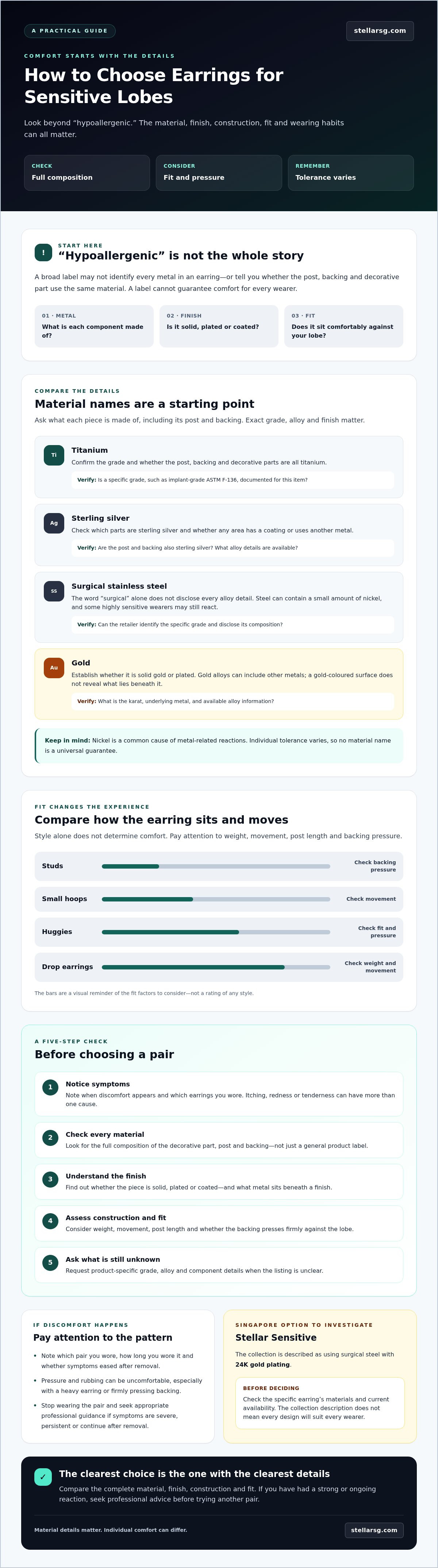
Look for stated materials for the post, backing, base metal, and any plating. Check whether a claim such as “titanium” or “gold” describes the complete earring or just one component. If the listing does not say, ask the retailer to clarify before buying. For more local shopping context, read the ultimate guide to buying earrings in Singapore.
Keep your questions specific to the design you are considering. A material description for one item may not apply to another, even if both appear under the same product range. Clear details make comparisons more useful; a general “hypoallergenic” label cannot fill in undisclosed composition.
Start with limited, ordinary wear rather than assuming a new pair will feel comfortable all day. Notice whether the earring feels heavy, shifts, or presses against your lobe. Remove it if discomfort begins, and do not repeatedly test a pair if symptoms are worsening. If discomfort recurs or persists, seek appropriate professional advice rather than trying to diagnose the cause yourself.
Stellar Sensitive is a collection to consider as you compare earrings, not a promise that a particular pair will suit every wearer. Its collection page describes the earrings as made in the USA using surgical steel with 24K gold plating, and positions them for people concerned about nickel sensitivity. Treat these as collection-level descriptions until you have checked the details for the specific design you are considering.
Before buying, confirm whether the listed material and finish apply to the individual earring, including its post and backing. Ask what the gold plating covers and whether the page identifies the metal beneath it. A finish and a base material are separate details, and your personal tolerance may differ from another wearer’s. Check current product information rather than assuming every design has identical construction.
This item-by-item approach helps you compare the collection fairly with other options. The best earrings for sensitive lobes are not the same for everyone, so weigh the stated composition alongside fit, construction, and your own experience. If a detail is unclear online, ask Stellar SG to clarify before making your choice.
Stellar SG has retail locations including ION Orchard and VivoCity, where shoppers may be able to explore earrings in person. Check whether the specific design you want is currently available at your preferred location before making a special visit. If you can inspect it, look closely at the post and backing, and ask staff to confirm the item’s current material details. An in-person look can help you assess appearance and construction, though it cannot predict how your skin will respond over time.
If you are choosing earrings for a new or recently pierced lobe, ask about the considerations relevant to that situation. You can also review Stellar SG’s professional ear piercing service information for details about its service.
Explore Stellar SG’s earrings and compare the available item details before deciding which pair to consider.
The best earrings for sensitive lobes depend on more than a “hypoallergenic” label. Check the full composition, including the post, backing, base metal, and any plating. Then consider weight, fit, and how the earring feels during wear. If discomfort is persistent or severe, pause wearing the pair and seek appropriate professional advice.
Stellar Sensitive is one option to explore. Its collection information describes surgical steel with 24K gold plating, but confirm the materials for the specific design you are considering. If you plan to visit a Singapore retail location, check current availability before making a special trip.
Explore Stellar SG’s earrings and review each item’s details before deciding. With thoughtful checks, you can choose your next pair with greater confidence and keep personal comfort at the heart of your style.
The best earrings for sensitive lobes are those with clearly disclosed materials and a comfortable fit for you. Check the post, backing, any plating, and the metal beneath the finish. Titanium, sterling silver, gold, and surgical stainless steel are common options, but their composition can vary. Consider weight and backing pressure too. No material or “hypoallergenic” label can guarantee that every wearer will feel comfortable.
Titanium may suit people who want to avoid nickel, especially when the specific grade is documented. Implant-grade titanium, such as ASTM F-136, is valued for biocompatibility and negligible nickel content. Surgical stainless steel can contain a small amount of nickel, which may still bother highly sensitive wearers. Do not rely on “surgical” alone. Compare the stated composition of each earring and consider your own experience.
Yes, gold-plated earrings can cause irritation for some wearers. Plating is a surface layer, so it does not identify the metal underneath, which may include an alloy that does not suit your skin. The coating can also wear over time. Before buying, ask what the base metal is and whether the post and backing are plated too. A gold finish alone does not confirm the full composition.
Sterling silver may work well for some people, but it is not automatically suitable for everyone. Check whether the post, backing, and decorative parts are all sterling silver, and ask what alloy details the seller can provide. An earring may include components made from other metals, even if its main section is described as silver. If you have reacted to a pair before, compare its exact composition with your new choice.
Check the product listing or packaging for the full composition of the post, backing, and decorative parts, not just a broad label such as “hypoallergenic.” If nickel content is not stated, ask the retailer or maker directly and request item-specific details. A “nickel-free” claim may not explain whether the product contains trace nickel or how much can be released. Do not assume that a gold-coloured finish means the earring is nickel-free.
Remove the earrings if your lobes become itchy or red, and avoid wearing that pair again while symptoms continue. Notice whether discomfort eases after removal, but do not try to diagnose the cause yourself. Pressure, friction, or a material reaction may be among the possibilities. If symptoms are severe, recurring, or persistent, seek appropriate professional advice before trying another pair.
Lightweight earrings may feel more comfortable because they can place less pull on the lobe, particularly during longer wear. But low weight does not address every comfort factor: material, post length, backing pressure, and movement matter too. A lightweight earring can still irritate if a component does not suit you or the backing feels tight. Assess the complete design and stop wearing it if discomfort begins.


