 欧元、澳元、英镑、日元、印度卢比


全部的: $0.00
结账时计算税费和运费
 SGD
SGD


Could a piercing feel perfectly professional in one Singapore workplace and out of place in another? If you’re asking what piercings are acceptable in the workplace, the answer depends less on the piercing itself and more on your employer’s policy, your duties, and the expectations for your role.
It’s understandable to feel uncertain, especially when appearance rules are unwritten or advice treats every job the same. A subtle ear piercing may raise different considerations from jewellery that could catch on equipment or affect hygiene. Interviews can add another layer: you want to make a confident impression without guessing what the organisation expects.
This guide explains what to check, from dress codes and customer-facing duties to practical safety requirements. You’ll also find ways to ask a manager or HR contact about expectations and plan around a healing piercing. With clear information, you can make a considered choice that suits your work environment.
There isn’t one answer to what piercings are acceptable in the workplace. Expectations vary by employer, role, safety needs, customer-facing duties, and the policy that applies to your team. In Singapore, one organisation’s standards shouldn’t be assumed to apply across every employer or industry.
A workplace dress code sets expectations for appearance, such as whether visible jewellery is allowed or a uniform must be worn. Task-specific safety rules have a different purpose. Jewellery may need to be secured or removed if it could snag on equipment, affect hygiene, or interfere with protective gear. An employer may also set presentation standards for customer-facing roles, but those expectations are not universal.
Body piercing has cultural and historical context beyond modern dress codes. For a broad overview, explore the history of body piercing. That context helps explain why workplace norms vary, but your employer’s current guidance is what matters for day-to-day decisions.
No. Employers, departments, and job duties may have different requirements. A written policy might set clear limits, while a team may also have informal expectations about presentation. Informal norms can help you understand a workplace, but they don’t necessarily replace or clarify official rules.
Piercing acceptability depends on the employer’s policy, the work being done, and whether the jewellery affects safety or presentation.
Start with the staff handbook, uniform guide, or other current written guidance. Look for details about whether piercings must be covered, whether jewellery size or visibility matters, and whether specific tasks have separate requirements. If a broad instruction such as “professional appearance” leaves practical questions unanswered, check rather than guessing.
Keep policy separate from legal assumptions. An employer’s appearance preference is not, by itself, proof of a universal legal requirement. Singapore employment guidance and relevant rules can change or depend on the circumstances, so verify any legal question with current official Singapore sources before relying on it. For a practical decision, first establish what your workplace requires.
Your daily tasks can matter as much as how visible a piercing is. The same jewellery may be fine during desk work but unsuitable for a task involving machinery, close contact, food handling, or protective equipment. These are practical examples, not automatic rules for every office, restaurant, clinic, or workshop in Singapore.
Consider what the role involves. An office job may have few physical hazards, though the employer could still have a dress code. A customer-facing team may be expected to follow a uniform or presentation standard. In food-handling or clinical settings, workplace procedures may address hygiene and jewellery. In hands-on roles, loose or protruding items could catch on tools, clothing, or equipment. Requirements depend on the task and employer, not just the industry label.
A snag risk may arise if jewellery can catch on machinery, tools, a uniform, or materials handled during close-contact work. Protective equipment also needs to fit and function as intended. If a piercing or its jewellery affects a required mask, helmet, hearing protection, or other equipment, ask how your workplace expects you to manage it.
Don’t improvise a workaround or assume that covering or swapping jewellery is acceptable. Follow the relevant safety procedure, and check with your manager or workplace safety lead if the requirement isn’t clear. A restriction may apply only while you’re doing a particular task.
They can. An employer may ask customer-facing staff to follow a dress code or wear a consistent uniform. That doesn’t mean every customer-facing job has the same standard, or that a particular piercing is automatically prohibited. Check the specific employer’s policy rather than relying on assumptions about hospitality, retail, healthcare, or another sector.
To work out what piercings are acceptable in the workplace, consider both the appearance guidance and your actual duties. You could ask: “Could you clarify whether the dress code or safety requirements apply to visible ear jewellery during my usual tasks?” If your role involves specific equipment or hygiene procedures, mention that task when you ask.
Once you understand the requirements, you can make an informed choice about jewellery or future plans. If you’re considering an ear piercing, learn more about Stellar SG’s professional ear piercing service, then consider whether the timing and workplace expectations suit your circumstances.
Visibility can shape first impressions, but it’s only one part of the decision. An ear piercing that’s easy to see may be compatible with your work, while less visible jewellery could still interfere with a task or conflict with a specific rule. The useful question isn’t which placement is universally “professional,” but how visibility, task demands, and your employer’s policy fit together.
| Example | Visibility | Task compatibility | Policy status |
|---|---|---|---|
| Earlobe jewellery during desk work | Usually visible | May suit the task, depending on the jewellery and role | Confirm the dress code |
| Ear cartilage jewellery with protective equipment | May be visible | Check that equipment fits securely and isn’t affected | Ask if the requirement is unclear |
| Jewellery during hands-on work | Can be visible or covered | Consider movement, snagging, and the specific task | Follow the relevant workplace procedure |
These examples aren’t rankings or universal rulings. Jewellery size and secure fit may matter, but no single style guarantees suitability across all workplaces. Stellar SG’s piercing service is for ears, so these examples focus on ear piercings rather than suggesting the business offers other piercing services.
No. A discreet appearance may align with some presentation expectations, but it doesn’t override a written policy or task requirement. Appearance can influence perception, but your workplace’s rules and the demands of your role determine what’s permitted. Don’t assume a small stud is automatically allowed, or that a more visible ear piercing is automatically unsuitable.
Consider the full picture: how visible the jewellery is, whether it moves or could snag, whether it works with your uniform, and whether required equipment fits properly. If any task requirement is uncertain, ask your manager or safety lead before deciding what to wear. For more information about ear piercings, explore Stellar SG’s professional ear piercing service.
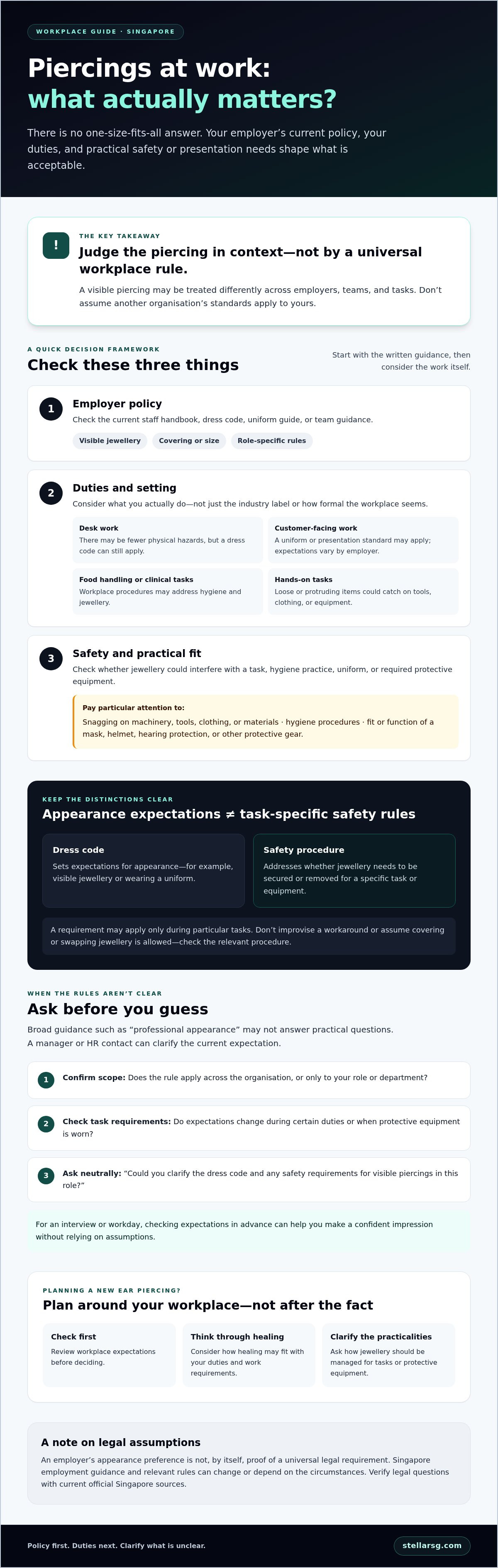
A calm, specific question can prevent guesswork without making your appearance the focus of the conversation. Before an interview or shift, use a simple sequence: review the written guidance, identify requirements tied to your role, ask the appropriate contact, then follow the answer.
For an interview, you could ask: “Could you share the dress-code expectations for this role, including whether there are guidelines for visible piercings?” If the job involves safety-sensitive tasks, add: “Are there any equipment or task requirements I should know about?” Ask the recruiter, manager, or HR contact best placed to clarify the role. A straightforward question shows you’re preparing thoughtfully.
If you already work there and the answer affects an important decision, ask your manager or HR contact before acting. If expectations are explained verbally, a brief follow-up message can help confirm what applies to your role.
Ask which written rule applies and whether it relates to appearance, a particular task, or both. You might say: “I’ve checked the uniform guidance, but I’m not sure how it applies to my duties. Could you clarify the requirement for this role?” If answers differ, request clarification from an appropriate HR contact and keep the exchange factual.
Don’t treat a workplace conversation as a legal ruling. If you need to understand your rights or interpret a legal requirement in Singapore, check current official Singapore resources or seek advice from a qualified professional. Avoid making a rushed choice based on uncertainty.
If a piercing is still healing, don’t remove or change its jewellery solely to meet an assumed dress code. Ask your employer about the requirement, and seek guidance from a qualified piercing professional or healthcare professional before changing jewellery. Once you’ve confirmed your workplace expectations and decided an ear piercing suits your plans, you can book an ear piercing appointment with Stellar SG.
A thoughtful plan keeps personal style and workplace expectations in view. Before deciding on a new ear piercing, take these steps:
This is more reliable than guessing what piercings are acceptable in the workplace based on appearance alone. The answer comes from your confirmed workplace requirements and how they relate to your role. If a policy or safety instruction remains unclear, ask your employer before deciding.
A professional ear-piercing service can help you understand the piercing experience and care considerations as you plan. It can’t interpret your employer’s policy or grant permission to wear jewellery at work. For ideas on styling different earrings, explore this earring styling guide, then check workplace requirements separately.
If you’re considering an ear piercing, review the details of Stellar SG’s professional ear-piercing service. Take time to consider your work schedule and any healing needs before choosing whether and when to proceed.
Read the service details first to decide whether they suit your plans. If you’re ready to explore further, see the ear-piercing appointment information. There’s no need to rush or choose jewellery before you’re ready. A considered choice starts with clear workplace expectations and guidance that supports your comfort and care.
The answer to what piercings are acceptable in the workplace depends on your employer’s policy, your duties, and any safety or uniform requirements. Check the current guidance and ask a clear, respectful question if anything is uncertain. A subtle style may feel appropriate, but it doesn’t replace confirmed workplace approval.
Before choosing whether or when to get an ear piercing, consider how healing and care may fit with your work routine. Personal style and professional responsibilities can sit comfortably together when your decision is informed and unhurried.
Stellar SG offers professional ear piercing in Singapore and a curated collection of earrings at its retail locations. If you’re ready to explore an ear piercing, explore professional ear piercing at Stellar SG.
With clear expectations and thoughtful planning, you can make a choice that feels true to you and right for your working life.
No, having piercings at work isn’t automatically unprofessional. Expectations depend on the employer’s policy, your role, safety considerations, and any stated presentation standards. A visible earring may be treated differently across workplaces, and duties involving equipment or hygiene can affect what’s practical. There isn’t one standard for every workplace. Check the dress code and ask your manager if the guidance is unclear.
It depends on the workplace policy, your job requirements, and any applicable rules. Check the staff handbook or uniform guide to see whether the request relates to appearance, a specific task, or safety equipment. If the instruction isn’t clear, ask your manager or HR contact which requirement applies. For a legal question, verify current Singapore-specific guidance with official sources or a qualified professional.
They may be acceptable, but expectations vary by employer and role. A workplace might set presentation standards for customer-facing staff, while another may have different guidance. Don’t assume every retail, hospitality, or service role follows the same rule. Check the dress code or candidate information, then ask the hiring contact or manager whether it covers visible facial jewellery. That gives you a clearer answer than relying on industry stereotypes.
They can. A workplace policy may cover earrings alongside other visible jewellery, or set separate requirements for uniforms and specific duties. Read the exact wording rather than assuming earrings are exempt. Look for guidance on visibility, jewellery size, or whether items need to be secured during particular tasks. If the policy doesn’t address your situation, ask your manager or safety lead before deciding what to wear.
Contact your employer to clarify the rule before changing your jewellery, and ask a qualified piercing professional for aftercare guidance. Explain that the piercing is healing and ask what requirement applies to your role or tasks. Don’t remove or change healing jewellery without appropriate professional advice. If the workplace has a safety concern, ask what approved options are available rather than improvising a workaround.
Check any candidate guidance first, then ask a neutral question such as, “Could you share the dress code for this role, including any guidance on visible jewellery?” This keeps the focus on preparation and expectations. If the job involves specific equipment or tasks, ask whether any related requirements apply. Avoid assuming the employer’s answer; seek clarification from the recruiter or hiring contact.
Requirements can differ between Singapore employers and roles, so don’t assume there’s one rule for every workplace. An employer’s written policy, job duties, and task-specific safety instructions may shape what’s expected. Check your employer’s current guidance, and ask a manager or HR contact if the wording is unclear. For legal information, consult current official Singapore sources or a qualified professional rather than relying on general assumptions.


