 欧元、澳元、英镑、日元、印度卢比


全部的: $0.00
结账时计算税费和运费
 SGD


What if a piercing that looks closed isn’t fully closed at all? If you’re wondering, “can a closed piercing be reopened?”, the answer depends on whether the channel has narrowed or sealed over. A small dimple may remain when a piercing has shrunk, while a fully closed channel may need to be pierced again. Either way, forcing an earring through can hurt delicate tissue and cause injury.
It’s understandable to feel unsure about trying jewellery again, especially if you’re worried about pain or another piercing. This guide explains why piercings narrow or close, what signs to look for, and why you shouldn’t push jewellery through at home. You’ll also learn what information to share when discussing your next step with a piercing professional. Stellar SG offers re-piercing for closed earlobe and cartilage piercings, with a new stud purchase required. Knowing the difference between a narrowed channel and a closed one can help you make a calm, informed decision.
Finding that an earring won’t slide into an old piercing can be unsettling, but difficulty inserting jewellery doesn’t prove that the channel has fully closed. The channel is the healed path through the tissue where jewellery sits. When jewellery has been out, the path may have narrowed, or the tissue may have sealed over. These are different situations, and the way the piercing looks at the surface may not show which one applies.
For general background on body piercing and its potential risks, see this Body Piercing Overview. For your own ear, don’t guess or push jewellery through. A trained piercing professional can assess the area and discuss the next step.
A shrunken opening may still lead to a channel; a closed channel has sealed and may need re-piercing.
When jewellery is removed, a piercing opening can become smaller. The channel may still be present, even if an earring no longer passes through easily. A visible dimple can’t confirm that the route beneath the surface is open, so don’t use appearance alone to decide whether it’s safe to reinsert jewellery.
The time and degree of narrowing vary. A piercing’s age, location and individual healing response can all matter, and earlobe and cartilage piercings may behave differently. The same amount of time without jewellery can therefore lead to different results for different people.
You can look at the front and back of your ear, but visual inspection can’t reliably show whether the channel remains beneath the surface. A tiny opening or dimple may be visible even when the passage has narrowed. Conversely, skin that looks closed doesn’t reveal exactly what is happening underneath.
Jewellery that won’t go in is a reason to pause, not a diagnosis. It may meet resistance because the channel has become smaller or because it has sealed. Don’t test it by pushing harder, repeatedly changing the angle or probing it with another object. Pain or resistance means stop rather than force it.
A trained piercing professional can assess the tissue and help distinguish a narrowed channel from a fully closed one. Repeated attempts at home may irritate or injure the area without answering the question. If you’re unsure, leave the jewellery out and arrange an assessment before deciding whether to pursue re-piercing.
Sometimes, but it depends on whether the original channel is still present. If it has narrowed rather than sealed, a trained professional can assess the area and discuss what may be suitable. If the tissue has healed over completely, there may be no channel to guide jewellery through, and re-piercing may be the appropriate option. You can’t reliably confirm either outcome by looking at the surface or trying jewellery at home.
So, can a closed piercing be reopened? A piercing that only appears closed might still have a narrowed path beneath the skin. A fully closed channel is different. A professional assessment considers the tissue and the piercing’s location, rather than relying on how the opening looks or how much pressure an earring takes.
A channel can become smaller while retaining its original path. That may explain why jewellery that used to fit now meets resistance or no longer passes comfortably. The opening and the route beneath it may have changed since you last wore jewellery, so past experience with a particular earring doesn’t tell you whether it will fit now.
Even if a channel remains, that doesn’t mean jewellery can be reinserted safely. A professional can assess it and discuss whether any next step is appropriate. Avoid testing the possibility yourself: pushing, twisting or changing the angle can irritate the tissue and make the situation harder to assess.
If the channel has healed completely closed, it may not be possible to reopen the original route. Re-piercing creates a new piercing and involves a new healing process, rather than simply restoring the old channel. Whether re-piercing is suitable, and where it should be placed, depends on an assessment of the area.
Scar tissue can affect the decision. A professional can examine the site and discuss an appropriate next step without assuming that every old piercing can be pierced in exactly the same place. If the area is painful, inflamed or otherwise concerning, share that information during the assessment.
A professional assessment matters because the surface can’t show whether a channel remains suitable to use. It replaces guesswork with a decision based on the individual piercing. A professional can discuss whether the channel appears narrowed or whether re-piercing may be the more appropriate route. Stellar offers re-piercing for closed earlobe and cartilage piercings, with a new stud purchase required. Learn about the ear piercing service before deciding on your next step.
After a new piercing, follow the aftercare guidance provided for your piercing. The Association of Professional Piercers shares general Professional Piercing Aftercare guidance, including how to care for a healing piercing. The right choice is individual, and you don’t need to decide before the area has been assessed.
A narrowed channel and a fully closed one can feel similar when you try to put jewellery in, but they call for different next steps. The safest choice isn’t to test how much pressure the opening can take. A piercing professional can assess the channel. If the area is painful, irritated or bleeding, stop and seek appropriate advice.
| What you may be dealing with | What it may mean | Safer next step |
|---|---|---|
| Narrowed channel | The original path may remain but be smaller, so jewellery may not pass easily. | Stop rather than push. Arrange a professional assessment. |
| Fully closed channel | The tissue may have healed over, leaving no channel to reopen. | Ask a piercing professional about suitable options, including whether re-piercing may be appropriate. |
This comparison explains the possibilities, but it can’t confirm what’s happening in your ear. You may be asking, “can a closed piercing be reopened?” The answer depends on the channel and tissue, not on how firmly an earring can be pushed through.
Force doesn’t show whether the original channel remains open. It can press jewellery against tissue that has narrowed or healed over, causing pain or irritation and making the area harder to assess. Even if an earring seems close to passing, that doesn’t prove it has followed the original path.
Don’t use sharp objects, improvised tools or unsterile jewellery to try to find or reopen the channel. Avoid puncturing, stretching or probing the tissue at home. These methods can injure the ear and introduce bacteria. If an earring doesn’t slide in easily, set it aside instead of trying again at a different angle or applying more pressure.
Stop immediately if insertion causes pain, visible irritation or bleeding. Don’t keep testing the opening to see whether the discomfort passes. Leave the area alone and arrange an assessment with a trained piercing professional to discuss whether the channel may be narrowed or closed.
If symptoms are significant or getting worse, seek advice from a healthcare professional. They can assess concerning symptoms and advise on care; don’t try to diagnose an infection yourself. The aim is a calm, appropriate next step, not alarm. Until you’ve received guidance, avoid inserting jewellery or putting tools into the piercing.
A professional assessment helps distinguish what may be considered from what should be left alone. It also avoids turning uncertainty into a painful trial at home. If you’re unsure about the channel, pausing is sensible. You can decide what to do once the area has been assessed.
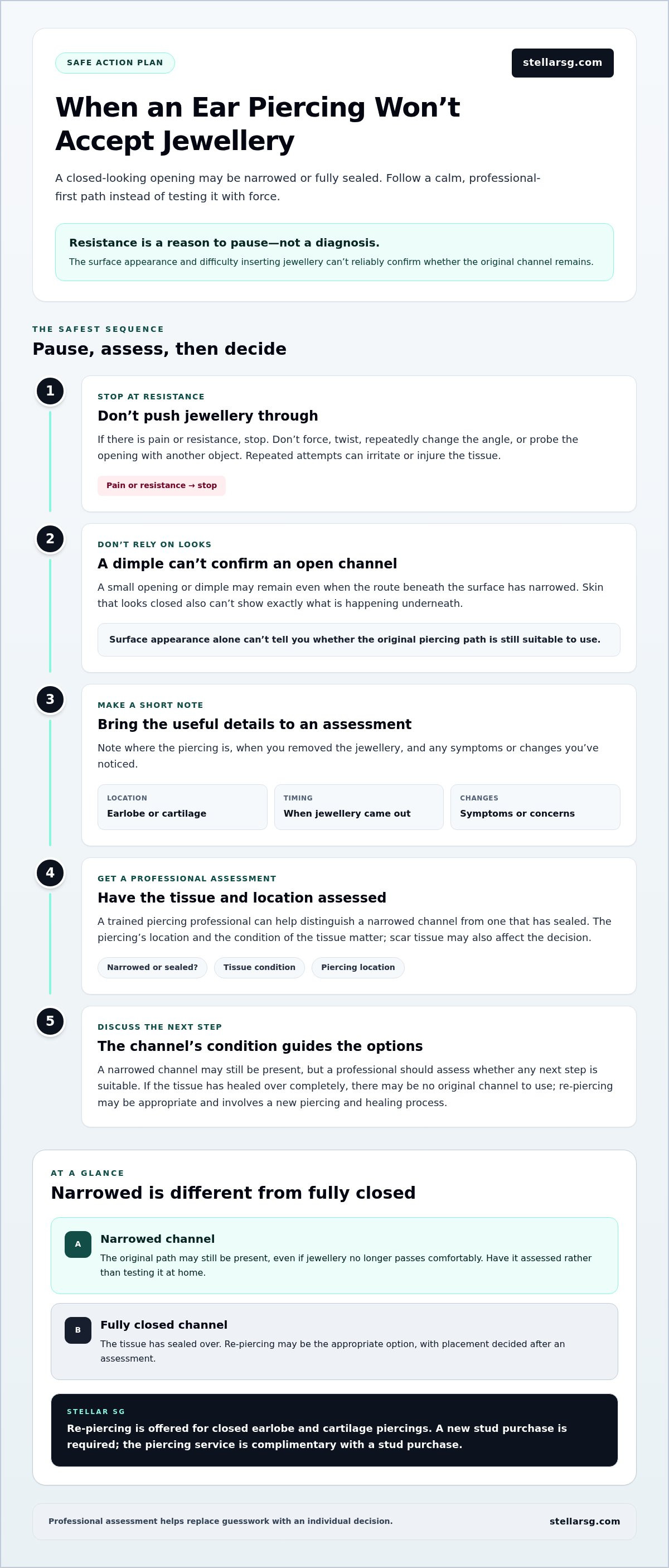
If an earring won’t go in, pause before trying again. A simple plan can help you avoid irritating the area and give a piercing professional useful information for discussing the next step.
Give a simple, factual account. Say whether the piercing is in your earlobe or cartilage/helix, when you removed the jewellery, and how long reinsertion has been difficult. Mention any pain, bleeding, irritation, swelling or other changes you’ve noticed. You don’t need to decide what the symptoms mean; describing what you’ve observed helps the professional understand the situation.
Leave the opening alone rather than repeatedly testing it with an earring. Don’t apply alcohol or personal numbing spray to try to reopen the channel, and don’t use sharp or improvised tools. Alcohol is discouraged for piercing aftercare, and numbing spray won’t establish whether a channel remains open. If symptoms are concerning, seek advice from a healthcare professional before proceeding with a piercing service.
At an assessment, explain what you’ve noticed and allow the professional to examine the piercing. The channel may remain but have narrowed, or it may have closed and need re-piercing. How much pressure an earring takes at home can’t reliably tell you which is the case. If you have significant or worsening symptoms, prioritise healthcare advice before considering the piercing itself.
It can help to remember the sequence: stop, observe, then arrange an assessment. Avoiding repeated attempts gives the area a chance to settle and keeps the decision focused on the tissue, not guesswork. Mention any previous discomfort or changes during your conversation, even if they seem minor.
If you’re ready to explore a professional next step, find ear piercing care and service details. Stellar offers earlobe and cartilage/helix piercing, including re-piercing after a previous piercing has closed. Re-piercing requires purchasing new studs, and the piercing service is complimentary with a stud purchase.
If an assessment suggests the original channel has fully closed, a new piercing may be the appropriate next step. Stellar offers re-piercing for previous piercings that have closed, for earlobes and cartilage/helix. Re-piercing requires purchasing new studs, and the piercing service is complimentary with a stud purchase.
So, can a closed piercing be reopened? If the channel has sealed, re-piercing is different from guiding jewellery through a narrowed path. A trained technician assesses the area before proceeding, so the next step is based on the piercing rather than guesswork. If you have pain, bleeding or other concerning symptoms, seek healthcare advice before proceeding with a piercing service.
Stellar’s technicians are certified after intensive training, and each performs more than 10,000 piercings annually. Stations and tools are sterilised daily, and the service uses disposable, USA-made hypoallergenic cartridges. Piercing is performed with an advanced hand-pressure instrument, not a spring-loaded gun. The instrument makes minimal sound and is designed for a virtually painless experience.
Piercing studs are available in solid 18 K gold, 14 K gold and medical-grade titanium, and include a round-cap backing. An alcohol-free after-care lotion is supplied with each stud purchase. A purchase of 14 K or 18 K gold studs also includes a Luna Rabbit gift, and a 20% OFF coupon for the Sensitive Series is included with the purchase.
Two complimentary consultations are included with the piercing package, along with alcohol-free after-care lotion. Alcohol is discouraged for aftercare, so follow the guidance provided for caring for your new piercing.
If you’re under 16, a parent or guardian must be present, or you’ll need written parental consent. Share the piercing location and any symptoms or changes you’ve noticed so the technician has useful context. You can book an ear-piercing appointment when you’re ready to plan your visit.
Knowing what to expect can make the decision more straightforward: a professional assessment first, followed by a discussion of the suitable next step. For a closed piercing, that may mean re-piercing with new studs. Explore professional ear piercing at Stellar Singapore.
If you’re still wondering “can a closed piercing be reopened?”, let that question guide a professional conversation, not another attempt to push jewellery through. You don’t need to decide in advance whether you want a new piercing. First, find out what may be suitable for your ear and your comfort.
When you’re ready, share what you’ve noticed and what you hope to achieve. An assessment can help you consider the next step with greater confidence, whether that means exploring re-piercing or taking more time before deciding. There’s no need to rush your choice.
Explore professional ear piercing at Stellar Singapore and plan your next step with care. Stellar offers ear piercing and re-piercing at its Singapore stores.
Yes, a piercing can narrow quickly, particularly if it’s still healing. A piercing less than six weeks old may begin closing within minutes or hours, while a newer piercing under six months old can close over hours or days. Timing varies from person to person and by piercing location. If an earring doesn’t go in easily the next morning, don’t push it through; get professional advice.
It can shrink, and sometimes close, even after years. A well-established earlobe piercing that’s been present for four or more years may remain open, but it can still become smaller when jewellery is left out. Cartilage piercings may behave differently. There’s no reliable timeline that applies to everyone, so don’t assume a long-standing hole will accept jewellery after a break.
No. Re-piercing at Stellar requires purchasing new studs, so personal earrings aren’t used for the procedure. This is separate from bringing an earring to test a closed-looking hole, which you shouldn’t force into the tissue. If you’re unsure whether you need re-piercing or have a narrowed channel, share that during the assessment before deciding on the next step.
Keep the new stud in continuously, including overnight, during the first year. For an earlobe piercing, wait at least two months before changing studs, and don’t remove it during the initial healing period. If you notice discomfort or changes before then, get professional guidance rather than taking the stud out or changing it yourself. Follow the aftercare instructions provided for your piercing.
Yes. At Stellar, customers under 16 must have a parent or guardian present, or provide written parental consent. This applies to the re-piercing visit as well as other ear-piercing appointments. Plan for the required adult or consent before booking. Stellar’s ear-piercing service is for customers older than two months.
No. Reopening means a professional may be able to guide jewellery through an existing channel that has narrowed. Re-piercing creates a new piercing when the old channel has closed. Which route may suit you depends on an assessment of the area, so the answer to “can a closed piercing be reopened” isn’t the same for every ear. Don’t try to determine it by forcing jewellery through.


