 欧元、澳元、英镑、日元、印度卢比


全部的: $0.00
结账时计算税费和运费
 SGD


A beautiful piercing studio isn’t automatically a safe choice. When you’re deciding where to go in Singapore, the red flags to look for in a piercing studio may be less obvious than its décor or jewellery display. Pay attention to how the team prepares, explains the process, and responds to your questions.
It’s reasonable to ask what clean preparation should look like. You shouldn’t feel rushed or pressured, have to guess which jewellery is suitable for a new piercing, or leave without understanding how to care for it. A respectful consultation gives you room to make an informed choice.
This checklist will help you assess hygiene, communication, jewellery, and aftercare before committing to an ear piercing. You’ll learn what to observe, which questions to ask, and how to judge whether the answers are clear. Focus on the visible process and the studio’s willingness to explain it as you compare options in Singapore.
A polished storefront can feel reassuring, but décor alone can’t answer practical safety questions. The red flags to look for in a piercing studio are gaps in hygiene, communication, consent, or aftercare, not differences in style. A minimalist space or a busy appointment schedule may simply reflect the studio’s approach. Staff dismissing reasonable questions or being unclear about the process deserves a closer look.
Before choosing an ear piercing service, check whether the studio explains what to expect and how to raise concerns. Its service information should help you understand what the service covers and where to ask questions. You can review ear piercing service information before visiting. Treat social media photos and testimonials as a starting point, not proof of how every appointment is handled.
Start with the information available online or by contacting the studio. Does it explain the process in clear terms? Can you ask about placement, jewellery, and care before deciding? In an initial conversation, notice whether staff invite questions and answer them plainly, or steer you toward an immediate commitment. The health risks of body piercing are one reason clear, thoughtful communication matters.
During a visit, observe what you can without trying to make a medical assessment. Is the work area visibly cluttered or unclean? Do staff seem prepared to discuss your concerns, or do they brush them aside? A single detail may have an explanation, so ask politely rather than assuming. What matters is whether the response is clear and respectful.
Use this short checklist during a visit or consultation:
A genuine warning sign is an unresolved gap that affects your ability to understand the service or make a comfortable choice. It isn’t the studio’s aesthetic or whether appointments feel formal. If an answer feels incomplete, ask a follow-up question. If staff continue to avoid it, pressure you, or dismiss your concern, you can pause or leave. You don’t need to commit simply because you’ve already visited.
Cleanliness isn’t something you need to judge by appearance alone. Follow a simple sequence: ask, observe, clarify, then decide. Ask how the studio handles single-use items and reusable instruments. Observe the preparation before the piercing begins. If anything is unclear, ask for an explanation. You can pause or leave if your concern remains unresolved.
The Association of Professional Piercers’ guide to choosing a piercer offers further questions to consider. Use it as a reference, then look for answers that describe a process rather than relying on broad assurances such as “everything is sterile.”
Ask which items are single-use and how reusable instruments are cleaned and sterilised between clients. A clear answer should tell you what happens, rather than leave you guessing. The Association of Professional Piercers recommends sterile, single-use needles, opened in front of the client and disposed of in a sharps container after use. Reusing an item described as single-use, or receiving an evasive answer about instrument handling, is a reason to stop and clarify before proceeding.
For reusable equipment, ask whether the studio uses a medical-grade autoclave and how it checks that the equipment is working. Association of Professional Piercers guidance specifies regular spore testing. A studio should be able to explain its process without brushing off the question.
Watch the preparation, not just the finished space. The practitioner should prepare the work area before beginning, and you should see fresh disposable gloves used for your appointment. If gloves touch something that could compromise cleanliness, ask whether they’ll be changed. A calm, clear response is more useful than a confident promise that you don’t need to worry.
An autoclave is a sterilising device that uses pressurised steam to process reusable instruments. Its presence alone doesn’t tell you how it’s maintained or used, so ask about the process rather than treating equipment on display as proof.
These are practical red flags to look for in a piercing studio, not a reason to make medical conclusions from a quick glance. If the answers are clear and the preparation matches what you were told, you can make a more informed choice. To review service details before a visit, see the ear piercing service information.
A thoughtful consultation gives you time to understand the proposed placement, the starter jewellery, and the care information relevant to your piercing. You should be able to ask questions without feeling that you’re holding up the appointment. If you’re hurried, mocked, or pressured after expressing uncertainty, pause rather than ignoring your instincts.
The Association of Professional Piercers guidelines offer a useful reference for questions about a piercer and studio. Use the consultation to check whether the answers are clear and specific to the service being discussed.
The practitioner should explain the proposed placement and give you a chance to ask questions before beginning. If you’re unsure, they should take your concern seriously rather than rushing you toward a decision. You can ask to pause, change your mind, or decline before the procedure starts. Consent should feel informed and unpressured. Similar principles of patient consultation and clear communication apply across the wider body art industry, where dedicated spaces such as Krets Tattoo prioritize unhurried collaboration so clients feel completely comfortable with placement before any procedure begins.
Ask what material and style are being offered, and why they’re suitable for a new piercing. A helpful answer identifies the material rather than relying on vague terms such as “hypoallergenic.” The Association of Professional Piercers lists options such as implant-grade titanium, implant-grade niobium, and solid 14k or higher nickel-free gold for initial jewellery. If staff can’t explain what you’re choosing, ask them to clarify before proceeding.
For more detail on safe metals for ear piercing, consult the Association of Professional Piercers’ guidance and use it to frame follow-up questions. Be cautious of unsupported assurances or answers that don’t address the material itself.
These are useful red flags to look for in a piercing studio because they affect your ability to make an informed choice. Answers don’t need to be elaborate, but they should address your question. If a response still leaves you uncomfortable, take more time or choose not to proceed.
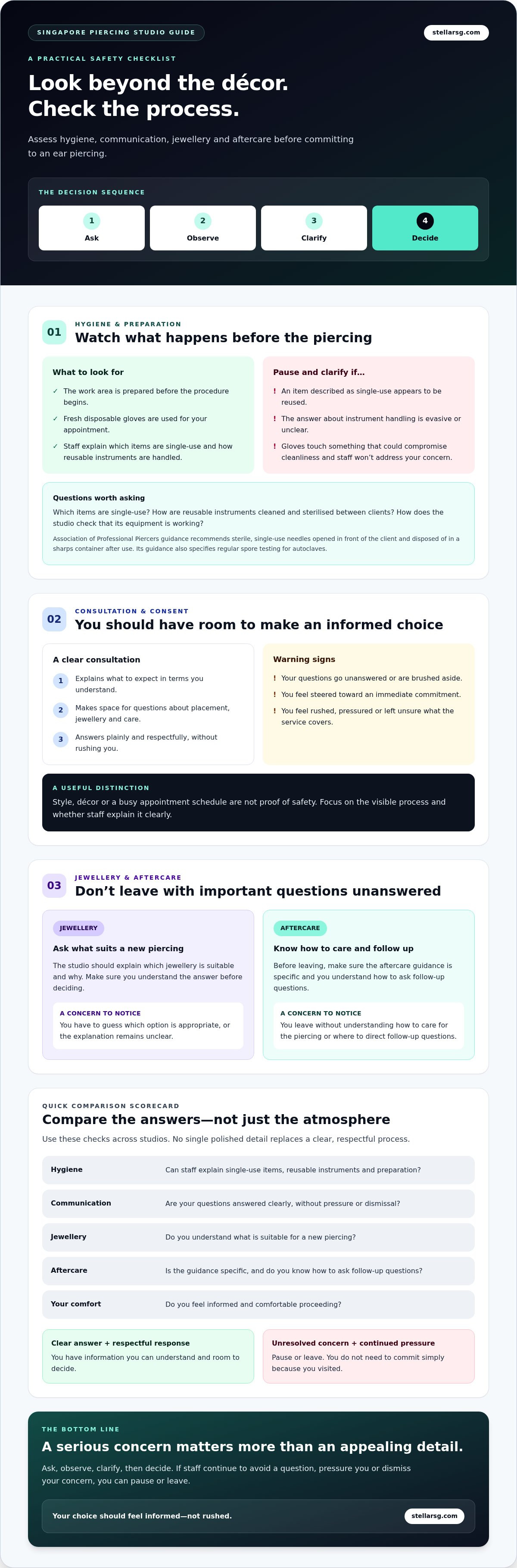
Aftercare is part of a transparent piercing service, not an afterthought. Before you proceed, find out whether guidance will be provided verbally, in writing, or both. You should leave knowing how to care for the piercing, what handling to avoid, and how to ask questions if something is unclear later.
Vague instructions such as “just keep it clean,” conflicting answers from staff, or no clear route for follow-up questions are red flags to look for in a piercing studio. They don’t establish that a problem will occur, but they can make it harder to make informed choices after your appointment.
Look for practical instructions that explain routine cleaning, hand hygiene, and how to avoid unnecessary touching or irritation. For example, the Association of Professional Piercers recommends sterile saline for cleaning and advises against twisting or rotating jewellery. The studio should also explain how to reach someone with service-related questions after your visit. Don’t rely on a promised healing timeline as a guarantee, since healing varies. If you’re concerned about symptoms or your health, contact an appropriate healthcare professional rather than trying to diagnose the issue yourself.
Compare what the studio says in person with its written service information. If the instructions conflict, ask which guidance you should follow and request a clear explanation. If essential questions remain unanswered, pause the appointment. Take time to understand the care involved before deciding whether to proceed.
A helpful studio won’t need to promise that every concern can be resolved on the spot. It should be willing to explain its aftercare guidance and clarify where its support ends. If you develop a health concern, seek advice from a healthcare professional.
Reviewing service details before visiting can help you prepare questions about care and follow-up. Explore Stellar SG’s professional ear piercing service information as one step in your research.
A simple scorecard can help you compare piercing studios in Singapore without letting an elegant interior or polished social media profile make the decision for you. Ask each studio the same questions, and record the answers separately from your visual impressions and online reviews. That makes it easier to judge how clearly the service is explained and whether you feel respected during the conversation.
Keep your comparison focused on what you can verify. For each studio, note whether staff explain preparation, answer questions clearly, respect your choice, identify the jewellery material, and provide understandable aftercare guidance. You can also read about ear piercing in Singapore to prepare, but use direct answers about the specific service as your main comparison.
Use this compact scorecard. Mark each item clear, unclear, or unresolved concern:
Don’t average away a serious unresolved concern because the other details seem appealing. A beautiful display or positive review can’t answer a question staff have left unanswered. If a response is unclear, ask again. If you’re still pressured or uncertain, pause and compare another option—you can also check out Artists Hairstyle Barbershop to see how full-service body piercing and styling studios present their work.
Consider proceeding only when the explanations about the process, jewellery, and aftercare make sense to you and you feel comfortable with the consultation. Before booking at a Singapore location, confirm its current service information and appointment requirements. If you’re comparing several locations, ask the same questions at each one so your decision rests on the answers, not assumptions.
Review Stellar SG’s ear piercing service details at your own pace. If the information addresses your questions and you feel ready, you can check ear piercing appointment booking. There’s no need to rush. The red flags to look for in a piercing studio are concerns that remain unresolved after you’ve asked for clear answers.
The red flags to look for in a piercing studio are gaps in the process: unclear hygiene practices, unanswered questions, pressure to proceed, or vague aftercare. A polished setting and attractive jewellery can be appealing, but they can’t replace clear explanations and a respectful consultation.
Before deciding, compare how studios explain preparation, placement, jewellery, and care. Ask the same questions at each Singapore location you’re considering, and don’t overlook a serious concern just because other details seem appealing. You deserve time to understand the service and make a comfortable choice.
Stellar SG offers ear piercing services at multiple retail locations in Singapore, alongside a curated selection of jewellery, including earrings. Explore the service information and decide at your own pace: explore Stellar SG’s ear piercing service.
Not by itself, but the method deserves a clear explanation. Ask which method the studio uses for your requested ear piercing and why it recommends it for that placement. Professional guidance favours sterile, single-use needles, particularly for cartilage, while piercing guns can cause blunt force trauma. Ask how equipment is handled, too. If staff dismiss your questions or pressure you to proceed, pause and consider another studio.
Look for a work area prepared before the procedure, appropriate hand hygiene, and clean gloves. Ask which items are single-use and how reusable instruments are processed. Observe what you can, then ask about anything unclear. A tidy appearance alone can’t confirm every step, so the red flags to look for in a piercing studio include visible gaps and staff unwillingness to explain their process clearly.
Yes. You can pause or decline before the piercing begins, especially if you feel pressured or still have unanswered questions. You don’t need to justify changing your mind. Calmly tell the staff you’re not ready to proceed, then leave if you prefer. A respectful interaction should accept your decision without making you feel guilty or hurried. Take the time you need to feel comfortable with your choice.
Ask how your ear piercing will be performed, which items are single-use, and how reusable instruments are processed. Find out what material the jewellery is made from, why it’s offered, and what aftercare guidance you’ll receive. You can also ask whom to contact with follow-up questions. Compare how clearly and respectfully each studio answers. Specific explanations help you make an informed choice, while broad assurances or booking pressure may leave important details unresolved.
No. Reviews can describe other customers’ experiences, but they can’t verify every hygiene step or show how staff will respond to your questions. Read them alongside the studio’s service information, then assess preparation, communication, consent, jewellery explanations, and aftercare for yourself. If an important concern remains unanswered, consider another option, even if the studio has appealing reviews. Your own consultation can reveal details that testimonials don’t cover.
Pause before agreeing to the service. Ask again in simpler terms or request clarification from the practitioner who will perform the piercing. If the response remains vague, dismissive, or pressuring, you can leave and compare another studio. Don’t proceed just to avoid an awkward moment. If you have symptoms or health concerns after a piercing, contact an appropriate healthcare professional rather than relying on a studio alone.


