 SGD
 EUR
 AUD
 GBP
 JPY
 INR
Total: $0.00
Taxes and shipping calculated at checkout


For ear piercings in Singapore, choose a professional piercer who uses sterile, single-use needles rather than a piercing gun. Guns can be difficult to fully sterilise and may cause tissue trauma, so a piercer portfolio review in Singapore should look beyond attractive photos to assess placement, technique and healed results.
It’s natural to want an ear piercing that suits your anatomy and looks balanced, while feeling confident about how it’s done. A strong portfolio can help you judge whether a piercer’s work is clear, consistent and thoughtfully placed, but the images deserve a closer look.
This guide explains how to assess placement advice, photo quality and healed work, what to consider when choosing a studio, and which age requirements apply. Use these practical checks to review the evidence and make a more informed decision.
Ask how the piercer performs the piercing, how the proposed placement suits your anatomy, and what jewellery is used. The answers help you assess whether the consultation is thoughtful, rather than simply focused on recreating a photo.
A useful piercer portfolio review in Singapore connects visible results with the reasoning behind each placement. Look for specific examples, such as a helix piercing that follows the ear’s curve.
Placement should suit your ear’s shape, the available tissue and the jewellery chosen. The piercer should mark the proposed location, explain why it works for your anatomy, and let you view it from different angles before proceeding.
Piercings should pass through tissue perpendicularly. For a triple forward helix, the placements should follow the ear’s curvature and align with one another. In a portfolio, compare each piercing’s angle and spacing with the ear’s natural contours. Ask how the plan would change if your anatomy differs from the example.
Ask the piercer about their training, practical experience and approach to further learning. Then compare their answers with portfolio examples of the placement you’re considering, such as a helix or forward helix.
Experience matters most when it comes with clear explanations. Ask how the piercer plans placement, selects jewellery and approaches healing. A professional should explain these choices in plain language, not rely only on polished photos or credentials.
Before booking, ask: “What method do you use for piercing?”, “Why does this placement suit my ear?”, and “What jewellery and aftercare do you recommend?” A direct answer should explain the method and how the plan relates to your anatomy.
Ear placements differ in shape and planning. Earlobe piercings sit in soft tissue, while helix and forward helix placements involve cartilage. A conch sits within the inner bowl; a flat is positioned on the upper cartilage. These examples help you check whether a portfolio matches the placement you want, rather than judging experience by photo count alone.
Discuss the plan before arranging several piercings together. Ask the piercer to consider each location, how the jewellery may interact, and whether treating multiple areas could complicate healing or aftercare. Your anatomy and intended placements should guide the plan, not a fixed number of piercings per visit.
Fees can vary with placement, jewellery and the proposed session plan. The price depends on the case and is given after a quote request; placement and jewellery choices are among the factors that shape it. Compare what the quoted service includes rather than assuming different placements require identical work.
Choose a studio by looking beyond its portfolio: consider its piercing method, cleanliness, jewellery and communication. Ask how the process works, and notice whether you feel comfortable discussing concerns before the procedure.
Photos and online reviews alone can’t show how a studio handles hygiene, explains the process or responds to your questions. A polished image may not reveal placement details or jewellery suitability, while a review reflects one person’s experience.
Start with the method. Professional needle piercing is preferable to piercing guns, which can be difficult to fully sterilise and may cause tissue trauma. Ask how the studio keeps equipment sterile and whether it uses single-use needles. Clear answers help you understand the process before deciding.
Then consider the space and the interaction. The work area should look orderly, and the piercer should explain the planned placement, jewellery and aftercare in plain language. For lobe piercings, for example, the piercer should show where each mark will sit before proceeding. You should feel comfortable speaking up.
A photo captures one moment, not the full procedure or healing experience. A carefully framed image may not reveal how the piercer prepared equipment, discussed placement or explained aftercare. Reviews can offer useful context, but a positive rating can’t establish that every safety practice was followed.
Compare images with the studio’s explanations. Excessive blood, cleaner or marking residue is a warning sign, although small amounts can appear in fresh-piercing photos. Jewellery should have a mirror finish; dull or scratched-looking pieces deserve closer attention. Ask which jewellery products appear in portfolio images.
Use a short checklist during your studio assessment:
It’s natural to feel uncertain before a piercing, so take time to understand each step. If you see a practice that concerns you, pause the appointment or leave. A professional conversation should make the process understandable, not pressure you into a decision.
For a closer look at the service process, explore these ear piercing service details as part of your studio assessment.
A portfolio photo should let you inspect the piercing itself, not just the overall look. Check whether the entry point, angle, jewellery and surrounding skin are visible. Clear focus and even lighting make placement easier to assess. Dark, grainy or blurry images can hide details or make the result difficult to judge.
Start by checking the image at a useful size. Can you see where the jewellery enters the ear? Does the view show how it sits in relation to nearby cartilage or other pieces? A close-up can reveal alignment, while a wider view shows how earrings sit together across the ear. Each view offers different information.
Look for photographs from more than one angle. A straight-on image may make a piercing appear centred, while a side view can reveal its direction. Piercings should pass through tissue perpendicularly, so angle shots can help demonstrate placement. Newer piercers and apprentices commonly use angle shots to show their work. Judge what the image reveals, not the photographer’s style alone.
Black-and-white photos aren’t automatically poor quality, but they hide colour details. Redness, marking residue and the appearance of jewellery may be harder to assess. Compare a monochrome image with other examples where colour and skin detail are visible. A fresh piercing may show some blood, cleaner or marking residue; excessive mess is a warning sign.
Inspect the jewellery, too. Quality pieces should have a mirror finish. Dull or scratched-looking earrings are a reason to look more closely at the material and finish. A photo can’t prove that a piece is solid gold or suitable for sensitive skin. Ask which jewellery brands and products appear in the image, then consider whether the answer is clear and specific.
Use a simple viewing sequence: assess focus first, then placement, skin detail and jewellery. If an image looks beautiful but hides the piercing, it offers little evidence about technique. A portfolio photo can’t show whether the procedure was painful or how the piercing healed. Treat it as one part of your assessment, alongside the piercer’s explanations and healed examples.
For a cartilage placement, look for a view that shows the piercing against the ear’s contours. For several earrings, check the spacing and how each piece relates to its neighbours. These details make the portfolio more useful than a cropped image focused only on decorative jewellery.
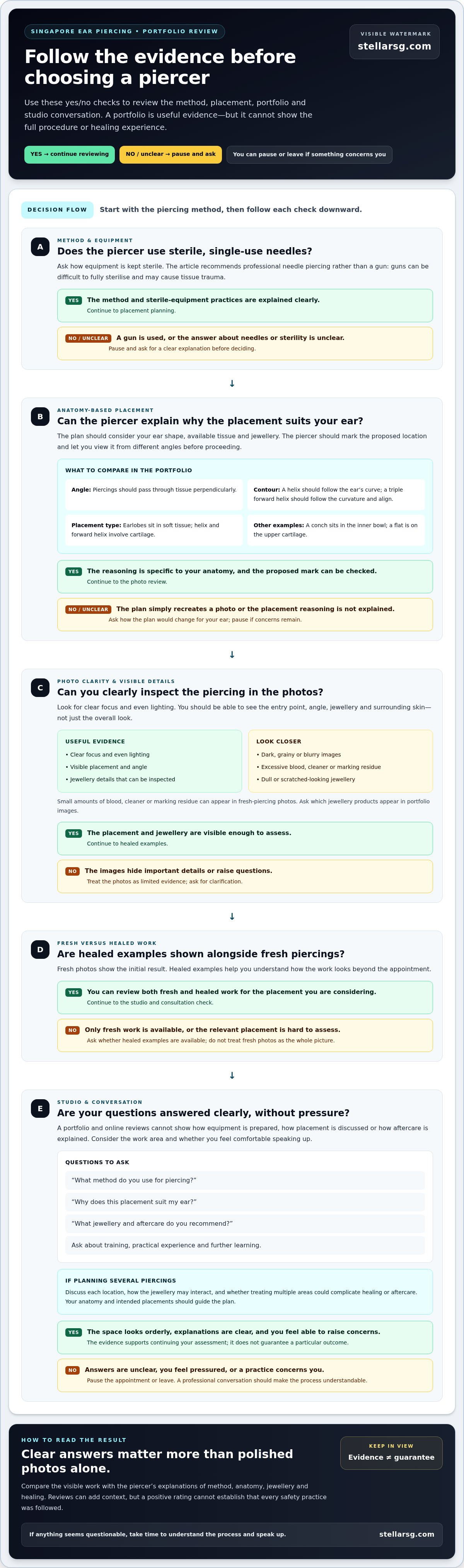
A fresh piercing shows the initial placement, jewellery and immediate appearance. A healed example offers a different view: how the piercing sits after recovery. Look for both in a portfolio, especially for cartilage placements, which take longer to heal than an initial appointment. Together, these images help you assess technique and the longer-term result.
Use a fresh photo to inspect the entry point, angle and jewellery fit. The skin may show some blood, cleaner or marking residue immediately after piercing. Focus on whether the placement is visible and the jewellery sits as intended, rather than expecting a fresh piercing to look like one that has fully settled.
Healed work helps you see whether the placement remains aligned and the jewellery sits naturally after recovery. For a helix piercing, full healing takes about six months. Cartilage piercings can take about six months to one year to heal. Those timelines make healed examples particularly useful when reviewing an ear project involving cartilage.
Compare the same placement across fresh and healed photos where possible. Look at the piercing’s direction, its position against the ear’s contours, and how the jewellery rests after healing. A fresh image alone can’t show the final appearance. A healed image alone may not reveal how the original placement was made.
Ask how long after the appointment a healed photo was taken and whether it shows the same piercing type you’re considering. These details give the image context. A healed lobe piercing, for example, doesn’t demonstrate the same placement experience as a healed helix. Compare like with like when assessing a portfolio.
Consider the whole ear, not just one piece. In a healed styling example, check whether nearby earrings sit comfortably together and each placement follows the ear’s shape. The arrangement can change as jewellery choices evolve, so look for clear examples of individual piercings as well as completed combinations.
Use this simple comparison when reviewing portfolio images:
A portfolio photo can’t rule out or diagnose an infection. Instead, use images to assess visible placement and ask how the piercer explains healing and aftercare. Look for healed examples alongside fresh work, then consider whether the piercer can discuss the choices behind both. This gives you a fuller picture than styling alone.
Use a simple sequence: ask about training, connect that learning to practical experience, then compare the answers with relevant portfolio work. In Singapore, this approach helps you assess what a piercer can explain and demonstrate without treating a certificate or polished profile as proof of every skill.
Begin with specific questions. Ask what training the piercer completed, who provided it, and which techniques it covered. Invite them to explain how the training informs equipment use, hygienic practice, jewellery selection and placement planning. A useful answer describes the process clearly, not just a course title or certificate image.
Next, compare experience with the piercing you want. If you’re considering a helix, look for examples of helix work rather than relying only on lobe photographs. Ask how the piercer learned to assess that placement and what anatomy they consider. The relevant comparison is the type of work, not an unsupported total of years or clients.
Credentials need context. A certificate can show that someone completed a particular course, but its title alone doesn’t explain the course’s scope or the piercer’s later practice. Ask what skills it covered and how those skills relate to ear piercings. Then look for consistency between the answer, the portfolio and the studio’s stated procedures.
Use a portfolio as a practical cross-check. For example, if a piercer describes careful placement planning, look for images where the piercing’s angle and position are visible. Ask whether the images show their own work and which jewellery products are pictured. Clear explanations connect a training claim with work you can actually assess.
Before booking, ask the piercer to describe the appointment, from placement discussion through aftercare. Notice whether they explain the choices behind the proposed location and jewellery, and whether they answer questions without rushing. A calm, specific explanation is more useful than an impressive-sounding title without details.
Keep notes on the training, examples and answers you review. If one piercer discusses a cartilage placement clearly while another shows only unrelated work, that distinction gives you a more practical basis for comparison. For next steps, view appointment booking details.
Stellar SG provides ear piercing for people ready to move from reviewing portfolios to considering their own piercing. Use the points in this guide to think about placement, jewellery and the examples that matter to you. Stellar SG also sells jewellery, so you can explore piercing and earrings in one place.
A portfolio review can help you make a considered choice, whether you’re drawn to a simple lobe piercing or a curated ear look. Reflect on the style and placement you prefer, then explore Stellar SG’s piercing service and jewellery.
Visit stellarsg.com to explore Stellar SG’s ear piercing service and jewellery.
Your next step can be a simple personal brief: note the look you want, the placement you’re considering and what would help you feel at ease. That gives you a clear starting point for a conversation and grounds your decision in your preferences. A piercer portfolio review in Singapore can inform your choice, but your final plan should feel right for you, not simply reproduce someone else’s styling.
Stellar SG provides ear piercing and sells jewellery, bringing the piercing experience and jewellery selection together. Explore these options as you consider the look you’d like to create.
Contact Stellar SG about ear piercing and take your next step with confidence.
Stellar SG uses an advanced hand-pressure piercing instrument, not a spring-loaded gun. Its disposable earring cartridges are made in the USA and hypoallergenic. The piercing studs have a round-cap backing, and each stud purchase includes free aftercare lotion. Ask what instrument and cartridge will be used for your appointment to understand the method before choosing.
Look for a portfolio with examples relevant to your intended placement, such as lobe and helix work. Useful captions identify the piercing type and whether each image shows fresh or healed work. Clear jewellery details can also help you understand the finished look. When comparing images, check whether they show different ears and placements, rather than several similar photos of one styling arrangement.
Start with a studio’s official website and social media accounts, then look at public customer reviews on business listing platforms. Confirm that the portfolio account is linked to the studio you’re considering, since names and images can be shared or reposted. Read reviews for details about communication, the appointment experience and aftercare, not just the overall rating. Use these sources together to form a fuller impression.
Compare studios using the same criteria rather than ranking star scores alone. For each, note whether the portfolio shows your preferred placement, whether images are clearly labelled, and whether reviews describe specific experiences. A detailed review about a helix appointment may be more relevant than a general rating. Treat ratings as one perspective, then weigh them alongside the work and the studio’s explanations.
Check whether photos identify the piercing type and stage shown. A fresh image documents the initial result; a healed image shows how that piercing looks later. If a portfolio includes a sequence, compare placement and jewellery across images, while noting whether the jewellery changed. Avoid treating different ears or piercing types as direct comparisons, since they don’t show the same progression.
Use Stellar SG’s appointment channel and describe the placement you’re considering, such as a lobe or helix piercing. Share the portfolio examples you want to discuss, then ask what the consultation covers. Two complimentary consultations are included with each piercing package. Use one to discuss your preferred look and jewellery choices as you plan your ear piercing.


