 SGD
SGD EUR
EUR
 AUD
AUD
 GBP
GBP
 JPY
JPY
 INR
INR
Total: $0.00
Taxes and shipping calculated at checkout


What if your ear curation didn’t need to come together all at once? The most considered looks are built over time, with each placement chosen to suit your ear, your everyday routine, and the style you want to express. If you’re wondering how to start an ear curation project, begin with a plan, not a rush to book several piercings.
It’s natural to have plenty of inspiration and still feel unsure which pieces belong together. A placement that looks beautiful in a photo may not suit your anatomy or feel practical for your lifestyle. A flexible plan lets you compare how ideas might balance across both ears, keep track of what matters most, and leave room for your preferences to change.
This guide will help you gather inspiration, map out possible placements, and consider comfort and timing before making decisions. You’ll also learn how to share your ideas and questions clearly with a professional piercer. At a professional ear-piercing appointment at Stellar SG, you can discuss your style and placement preferences as you shape a considered plan, one step at a time.
It’s exciting to imagine a more considered arrangement of earrings, but deciding where every future piercing should go can feel like a lot. Will the placements suit your ear? Will the pieces feel balanced together? You don’t need to answer everything at once. An ear curation project is a plan for how existing piercings and possible future ones might work together, with room to adjust as your ideas take shape.
An ear curation is a personal design plan shaped by your anatomy and style. It helps you think about the whole ear rather than choosing each piercing in isolation. You can explore the look you want without treating every idea as an immediate commitment. For broader background on earrings, see the Earring - Wikipedia overview.
A cohesive impression comes from how the details relate: placement, scale, spacing, and visual balance. A small stud near a larger feature can create contrast; several delicate pieces may create a quieter rhythm. The pieces don’t need to match exactly. Repeating a shape or keeping a similar visual weight can connect different earrings, while a deliberate contrast can make the arrangement feel individual rather than mismatched.
Start with what’s already there. Existing piercings are part of the composition, not obstacles to work around or blank spaces to fill. For example, if you have a prominent lobe earring, you might imagine a subtler accent nearby or consider how an upper-ear placement could balance the overall impression. Treat these as ideas to discuss, not guaranteed placements. Your anatomy shapes what may be suitable, and a reference photo can’t promise an identical result.
Yes. Think of your first concept as a direction, not a finished set. Begin by noting the look you’re drawn to, then leave possible additions as ideas for later. Your preferences can shift, and work, hobbies, or everyday comfort may change what feels practical. A flexible plan lets you revisit the arrangement rather than feeling bound to an old reference or an ambitious shopping list.
Visual planning isn’t the same as committing to every piercing. Mark ideas as “now,” “maybe later,” or “not sure,” and give yourself permission to change the order or remove an option. Any new piercing also needs appropriate time and care to heal, so avoid treating a sketch as a schedule. When you’re ready to explore a placement, a professional piercing appointment at Stellar gives you a chance to discuss your preferences in relation to your individual ear.
Before choosing new placements, make a simple record of what you have and how you want your finished look to feel. This turns “I like that ear” into details you can discuss: where visual weight sits, how much space you prefer between pieces, and whether you’re drawn to a subtle or expressive arrangement. If you’re considering how to start an ear curation project, begin by collecting observations, not by trying to diagnose your ear or settle every placement yourself.
Look at each ear from the front and side in a mirror. Note existing piercings, areas you’d like to highlight, and parts you’d prefer to keep visually open. You don’t need to decide what your anatomy means for a particular piercing. Ear shapes vary, so the same reference placement may not translate in the same way for everyone. At a professional ear-piercing appointment at Stellar, you can discuss your inspiration and preferences in relation to your individual ear. For an overview of possible placements, explore Stellar’s complete guide to ear piercing types and styling.
Create a small reference folder rather than saving every look that catches your eye. Choose images that share a clear quality, such as delicate spacing, sculptural shapes, understated pieces, or one noticeable accent. Add a short note to each image explaining what appeals to you. It may be the distance between earrings, the contrast in size, or the overall mood, rather than the exact piercings shown.
Keep your notes practical. Try a list like this:
Your routine belongs in the design conversation. A placement or earring that appeals in a reference may feel less practical if it regularly meets a headphone, helmet, or work dress code. You don’t need to rule out the idea immediately. Mark it as something to discuss, alongside the details that matter most to your comfort.
For more ideas on combining earrings, Stellar’s guide to curating an ear stack can help you explore different visual directions. Bring a few references and your notes to a professional piercing appointment at Stellar in Singapore. You can talk through your preferred look and placement ideas as they relate to your ear. If you’re ready to discuss piercing options, you can book an ear-piercing appointment and bring your ideas along.
Once you have a sense of your preferences, choose an overall mood before deciding on every placement or earring. You might want a calm, delicate arrangement, a more expressive composition, or a different balance on each ear. There’s no single direction that works for everyone. Identify what feels like you, then adapt that idea to your existing piercings, anatomy, and comfort.
A reference image offers direction, while a personal plan accounts for the wearer. Use saved images to spot qualities you like, not as a template you need to reproduce. The same arrangement can look and feel different on another ear, so keep the mood or design detail in mind and stay open about the exact placement.
Start broad. A minimal look gives each piece room to stand out, while a statement-led approach creates a stronger focal point or a fuller impression. “Balanced” can mean similar visual weight on both ears, while an asymmetrical direction uses different arrangements that still feel connected. These are starting points, not fixed rules; your plan can combine them.
| Style direction | Visual effect | Planning prompt |
|---|---|---|
| Balanced | A similar sense of visual weight across both ears | Do you want the ears to feel alike without matching exactly? |
| Asymmetrical | Different arrangements with a shared mood or detail | What could connect the two sides? |
| Minimal | More open space and emphasis on a few pieces | Which details deserve the most attention? |
| Expressive | A stronger focal point or more noticeable variation | Where would you like the eye to land first? |
As you compare directions, consider how each might work with the piercings you already have. A reference with several prominent pieces may inspire you to use one focal detail instead, while a sparse arrangement might prompt you to preserve more open space. If you’re exploring how to start an ear curation project, choosing a mood first gives you a useful filter for later decisions without locking you into a complete set.
Harmony doesn’t require every piece to match. Look for one or two links between them: a repeated shape, complementary sizes, a similar visual weight, or spacing that creates an easy rhythm. Distinct earrings can still feel considered if their proportions work together or one detail is echoed elsewhere. Deliberate contrast can also create cohesion when the rest of the arrangement feels intentional.
Try sketching the overall balance or arranging your ideas in a simple ear map. Note what you want to keep, what you’re willing to adapt, and what may not suit your comfort or anatomy. The most useful plan preserves the feeling that drew you to an image while leaving the final design personal.
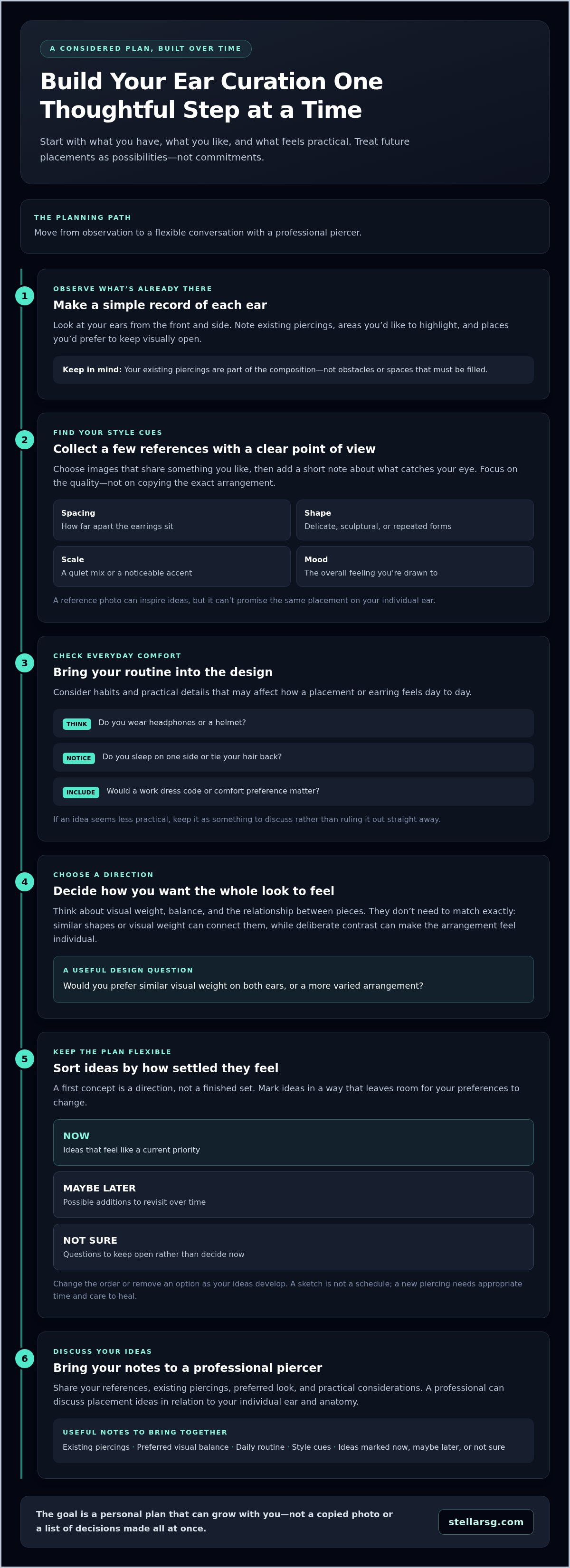
A little structure can make your inspiration easier to discuss and revise. The goal isn’t to map every future piercing perfectly. It’s to capture what matters to you, then use that brief to guide a professional conversation. This is a practical way to approach how to start an ear curation project without treating every saved image as a final decision.
Keep your notes in one place, such as a phone document or a page in a journal. Make them clear enough for someone else to understand your preferences, but leave placement decisions open for discussion. Include these details:
Keep the brief focused on your preferences, not on diagnosing your anatomy or promising yourself a particular placement. “I like open spacing and one focal point” gives a professional a useful starting point. “This exact placement will suit me” closes off a conversation that should take your individual ear into account.
Next, sort possible additions into three groups: must-have, open to, and maybe later. A must-have could be the overall feeling you want, rather than a specific piercing. An optional idea might be a placement you like in photos but haven’t decided on. This ranking separates the elements that define your style from details that can change.
Then use a simple planning sequence:
A professional conversation can help refine the plan without requiring you to commit to every idea at once. At Stellar, our professional ear-piercing service gives you the opportunity to discuss your preferences and placement ideas with attentive guidance. Share any comfort concerns, and follow tailored professional aftercare guidance for any piercing you choose to proceed with.
Your notes and references are useful tools for a conversation, not a script that has to be followed exactly. A professional appointment gives you space to explain the look you’re hoping to create and discuss how those ideas might translate to your individual ear. Placement possibilities depend on your anatomy and preferences, so the final plan may differ from a reference image. That’s part of making the design personal.
Bring your design brief, a few saved references, and a note of the piercings you already have. You don’t need a polished presentation. A phone folder and a short list are enough to explain what you like, what you’re unsure about, and which comfort considerations matter in your daily life.
Use the conversation to explore possibilities, not to seek a promise that a saved look can be copied exactly. For example, you might love the overall balance in an image but be open to changing the placement or scale so the idea responds to your ear. You can also ask how to keep your plan flexible if you’d rather consider future additions separately.
At Stellar, our professional ear-piercing service gives you a place to discuss your references and preferences with attentive guidance. Use the appointment to turn your ideas into a considered placement conversation, rather than feeling you must commit to every possibility on your plan. Bring the details that matter to you and stay open to a design shaped around your anatomy.
If you’re still learning how to start an ear curation project, preparing a few notes is already a meaningful first step. You don’t need to have every detail decided before speaking with a professional. When you’re ready to discuss your plan, book an ear-piercing appointment at Stellar.
Your ear curation doesn’t have to be finished before it begins. Treat your plan as a living expression of your style, one you can revisit as your preferences and everyday needs change. The most meaningful next step may simply be choosing the detail you’re ready to explore first.
If you’re considering how to start an ear curation project, a professional conversation can help you shape that first step with care. Stellar provides professional ear-piercing services in Singapore, alongside a curated selection of premium earrings at its retail locations. Bring the direction you have in mind and stay open to refining it around what feels right for you.
When you feel ready to move from ideas to a placement discussion, book an ear-piercing appointment. Your plan can take shape at your own pace, with room for your personal style to lead.
Start by deciding which existing piercings you want to keep at the centre of your look. Note which earrings you wear most often and whether any placements feel uncomfortable or rarely suit your routine. Then consider how new ideas might complement those favourites rather than treating your ear as a blank canvas. If you’re learning how to start an ear curation project, this small inventory can make your next placement discussion more focused.
No, your ears don’t need identical piercings. You can choose different placements or earrings on each side and still create a considered overall look. One practical way to judge the balance is to view both ears together in a mirror, then notice whether one side feels more visually prominent. Matching one detail, such as shape or overall delicacy, can connect the sides without making them look like copies.
Yes. Photos are useful for communicating a mood or specific detail, but they can’t guarantee the same result on your ear. Before an appointment, annotate each reference with what caught your attention, such as the open space, the focal point, or the way small and larger pieces sit together. Camera angles, lighting, and individual anatomy can all change how a placement appears in a photo.
There’s no universal number to aim for. A curation can include the piercings you already have, with no new additions, or leave space for ideas you may explore later. Think about the visual effect you want and what feels manageable in your routine. A professional can discuss how your preferred placements relate to your anatomy, so treat a number from a reference photo as inspiration, not a target.
An ear curation can be planned with your workplace’s appearance guidelines in mind. If your role calls for a discreet look, you might favour a simpler arrangement or choose subtle earrings where they’re permitted. Review any workplace rules before settling on a direction, and consider how your choices may need to work across different occasions. Your plan can reflect personal style while respecting the expectations you encounter at work.
Yes. Different shapes, sizes, or finishes can sit together in a way that feels personal rather than uniform. For example, a simple piece beside a more detailed one can create contrast, while a repeated shape can bring the arrangement together. Consider the overall impression from a little distance, not only how each earring looks on its own. You can refine the combination as your preferences develop.
Bring a few saved references, a note of your current piercings, and any questions you want answered. It can also help to write down practical considerations, such as headphones you wear often or a comfort concern you’d like to discuss. You don’t need to arrive with every placement decided. At a professional appointment at Stellar, you can talk through your preferences and consider a plan suited to your individual ear.


