 SGD
 EUR
 AUD
 GBP
 JPY
 INR
Total: $0.00
Taxes and shipping calculated at checkout


A piercing tool can look clean and still require sterilisation. Sterilisation eliminates viable microorganisms; cleaning removes visible soil, while disinfection reduces many harmful microorganisms but is not the same as sterilisation. Autoclave sterilization for piercing tools uses pressurised steam, heat and controlled exposure time to sterilise compatible tools.
It’s natural to want to know what happens before a tool is used. Steam must reach the instrument for the required time and under the right conditions, so sterilisation involves more than simply heating it.
This guide explains the differences between cleaning, disinfection and sterilisation, and how steam, pressure, temperature and cycle time work together in an autoclave. You’ll also learn why the right cycle depends on the load and packaging, and how careful handling helps protect sterilised tools until use.
Cleaning, disinfection and sterilisation are distinct steps in piercing hygiene. Understanding what each does explains why a clean-looking tool still needs validated processing.
Cleaning removes soil and residue from tools and surfaces; disinfection reduces microorganisms on equipment and studio surfaces. Neither replaces sterilisation for reusable piercing tools. For example, wiping a work surface treats that surface, while a reusable instrument needs a separate process before it can be used again. Keeping these steps distinct prevents visible cleanliness from being mistaken for sterile preparation.
Before autoclaving, tools are cleaned, dried and packed individually in single-use paper peel-packs or other containers designed for instrument sterilisation. The piercer loads the packs according to the autoclave’s instructions, allowing steam to reach the instruments. Packaging supports the process and protects tools after the cycle. A piercing studio should ensure pre-sterilised packages are intact and open them in a way that preserves sterility.
Autoclave sterilisation uses pressurised steam and a controlled cycle; dry heat and liquid soaks are not suitable sterilisation methods for piercing tools. Boiling also does not kill 100% of microorganisms, so it isn’t suitable for sterilising tools or jewellery in a piercing shop. These distinctions matter because cleaning removes contamination, disinfection reduces it, and sterilisation is the required instrument-processing goal.
For clients, practical signs include individually packaged tools and careful opening at the procedure. An intact, sealed pack helps protect its contents from contamination before use; a torn or open pack cannot offer the same protection. The package should be opened so the instrument remains sterile until the piercer is ready to use it.
Look for a studio workflow that separates surface cleaning from tool sterilisation and handles packaged instruments carefully. A visible, intact pack is a useful sign of protected storage, but its appearance alone doesn’t prove that an autoclave cycle worked. Spore tests help check whether an autoclave is functioning correctly, providing monitoring beyond visual inspection.
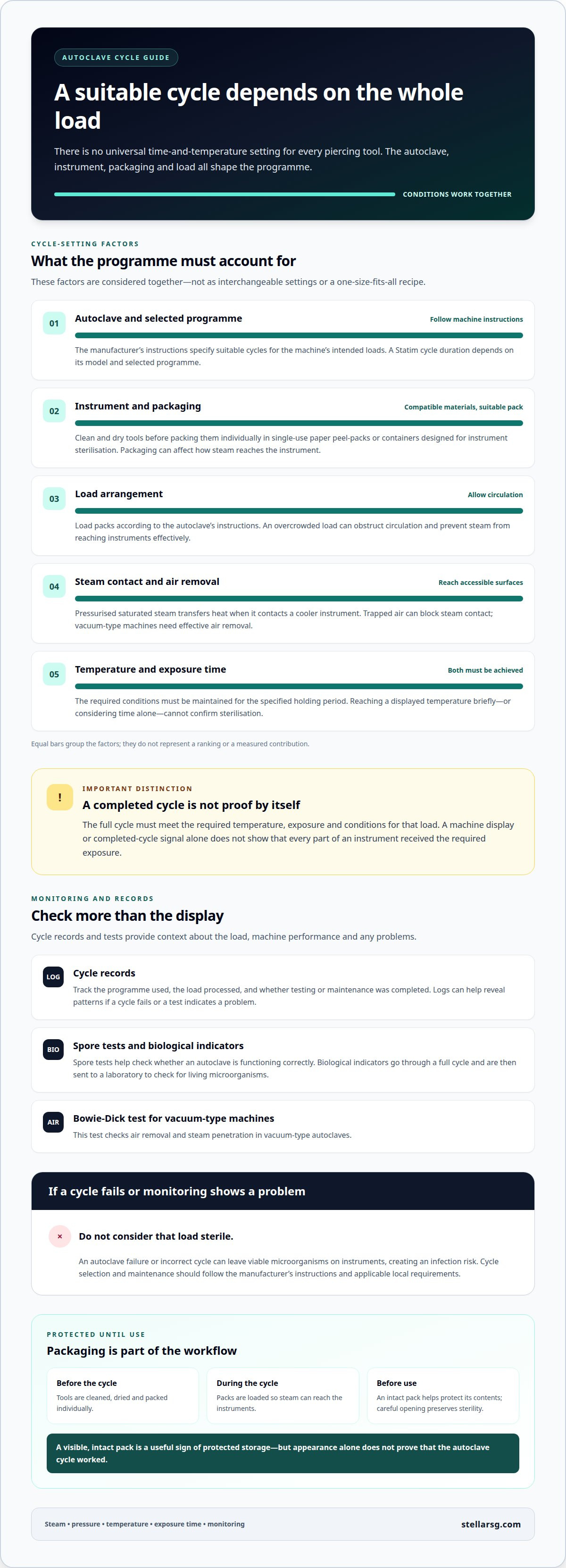
Temperature and exposure time work together, but piercing tools don’t all use the same cycle. The appropriate programme depends on the autoclave, instrument, packaging and load. A setting for one material or load cannot automatically be used for another.
The machine’s instructions specify suitable cycles for its intended loads. Packaging can affect how steam reaches an instrument, while an overcrowded load can obstruct circulation. A Statim autoclave’s cycle duration also depends on its model and selected programme. Time alone cannot confirm sterilisation: the required temperature, exposure and cycle conditions must all be achieved for that load.
Cycle records help studios track the programme used, the load processed, and whether testing or maintenance was completed. A clear log can also reveal patterns if a cycle fails or a test indicates a problem. Spore tests help check whether autoclaves are functioning correctly. Biological indicators go through a full cycle and are then sent to a laboratory to check for living microorganisms.
Vacuum-type machines need effective air removal so steam can reach the load. A Bowie-Dick test checks air removal and steam penetration in these autoclaves. Maintenance and test records add context to the cycle log, rather than relying only on the machine display or a completed-cycle signal.
An autoclave failure or incorrect cycle can leave viable microorganisms on instruments, creating an infection risk for the person being pierced. If a cycle fails or monitoring shows a problem, the load should not be considered sterile. In Singapore, cycle selection and maintenance should follow the autoclave manufacturer’s instructions and applicable local requirements.
An autoclave uses pressurised steam, heat and exposure time to sterilise compatible piercing tools. Each part of the cycle contributes to the process.
Pressurised saturated steam is water vapour at a temperature and pressure that allow it to transfer heat effectively. When steam meets a cooler instrument, it condenses and releases heat onto the surface. This contact is essential: pressure helps steam reach a high temperature, but pressure alone doesn’t sterilise a tool. Air removal, load arrangement and suitable packaging help steam reach the instrument during the cycle.
Steam autoclaving uses moist heat under pressure, while dry heat uses hot air without steam. These are different methods, and dry heat is not considered suitable for sterilising piercing tools. The distinction matters because the tool’s material and the validated cycle determine the appropriate processing method. A studio should use a programme designed for its instruments and load, rather than substitute a different heat method.
Temperature and exposure time work together. The cycle must maintain the required conditions for the specified holding period, not merely reach a target temperature briefly. Packaging and tool arrangement can affect steam contact, so the cycle must suit the load. A displayed temperature alone cannot show that every part of an instrument received the required exposure.
During processing, pressure allows steam to reach temperatures above its usual boiling point. When steam contacts an instrument, heat transfer exposes accessible surfaces to sterilising conditions. Trapped air around a tool can block steam contact. That’s why machine performance and careful loading matter alongside the selected temperature and time.
For clients, the key point is that autoclaving depends on the whole process, not one setting. Steam contact, pressure, temperature and time must work together. This explains why the machine, its cycle and the way tools are loaded all matter in reducing infection risks.
An autoclave is a machine that sterilises compatible tools by exposing them to steam under pressure. Its cycle must let steam contact the instruments, then maintain the required conditions for the selected load.
Inside the chamber, air is removed or displaced as steam enters. This matters because trapped air can stop steam reaching parts of an instrument. Once contact is established, heat moves across the tool’s surfaces and into areas the steam can reach. The programmed cycle controls exposure, while the load and packaging affect steam circulation. An overcrowded chamber or unsuitable pack can interfere with steam access.
After processing, each instrument remains protected by its packaging until use. Sterilised items are stored in sealed pouches to help prevent contamination. The pouch is opened at the procedure, with handling that keeps the instrument sterile until the piercer is ready. If the package is open, torn or otherwise no longer intact, it cannot offer the same protection.
In Singapore, piercing-tool sterilisation should follow applicable local health requirements and the autoclave manufacturer’s instructions. UK HTM recommendations are not Singapore rules and should not be presented as local requirements.
For clients, the clearest process is one where an intact, pre-sterilised pack is carefully opened at the point of use. Packaging protects the contents after the cycle, while careful handling preserves that protection. A sealed pouch alone doesn’t show how the tool was processed, so both the machine’s cycle and the studio’s handling matter.
For a carefully guided piercing experience, explore the ear piercing service.
Stellar SG offers an Ear Piercing Service for anyone ready to turn careful research into a personal piercing experience. If you’re considering an ear piercing, the service brings professional care to your next step, while the jewelry offers a finishing touch suited to your style.
Use what you’ve learned about sterilisation to understand why instrument processing and careful handling matter in a piercing setting. For your appointment, consider the experience you want and the jewelry you’d like to explore. Stellar SG offers both ear piercing and jewelry, making it easy to consider them together.
For a personal next step, contact Stellar SG.
Understanding autoclave sterilization for piercing tools gives you a clearer basis for considering the care involved in a piercing. Carry that knowledge into your next decision: think about the experience you want, the jewelry that reflects your style, and the questions that would help you feel comfortable before proceeding.
You don’t need to master every technical detail to take a thoughtful next step. Focus on your preferences and discuss your ear piercing with a professional who can guide you through the experience. A considered choice can make the process more personal, from the first conversation to selecting a look you’ll enjoy.
For a friendly conversation about your next step, contact Stellar SG. When you’re ready, take your time, explore the possibilities, and choose the experience that feels right for you.
Sterilisation is intended to eliminate viable microorganisms from an instrument. It differs from cleaning, which removes soil, and disinfection, which reduces microorganisms but does not achieve the same goal. For piercing tools, sterilisation addresses contamination that may not be visible. A tool can look clean and still require sterilisation before use, so appearance alone isn’t a reliable measure of its processing.
An autoclave exposes compatible instruments to steam under pressure for a controlled cycle. Steam must reach the surfaces being processed, so loading and packaging affect the process. For example, tightly packed instruments can limit steam contact. After the cycle, sealed packaging helps protect tools until use. The machine’s completed-cycle display is only one part of process control, not proof on its own that sterilisation succeeded.
A suitable autoclave is one whose instructions cover the studio’s instruments, packaging and intended load. The machine must support a cycle that lets steam reach the tools being processed. For example, a programme for unwrapped solid instruments shouldn’t automatically be used for packaged or hollow items. In Singapore, suitability also depends on following applicable local requirements and the manufacturer’s instructions for that specific machine.
There isn’t one temperature, pressure and cycle time that applies to every piercing instrument. The correct settings depend on the autoclave, tool material, packaging and load. Pressure and temperature work together to create steam conditions, while the cycle must maintain them for the required exposure. Use the machine’s validated programme for the specific load, rather than choosing settings based on temperature alone.
Chemical indicators respond to specified process conditions and can show whether a pack or load encountered them. They don’t establish on their own that an instrument is sterile. Biological indicators assess the cycle using resistant spores; after processing, they’re sent to a laboratory to check for living microorganisms. These indicators provide different information, so studios use them as part of broader monitoring and recordkeeping.
Testing and servicing schedules should follow the autoclave manufacturer’s instructions and applicable Singapore requirements. Keep records of cycle programmes, monitoring results, maintenance and failures so the processing history is traceable. Biological testing frequency should also follow those instructions and requirements. If monitoring identifies a problem, the affected load shouldn’t be considered sterile until the issue is resolved and processing is supported by appropriate checks.


