 欧元、澳元、英镑、日元、印度卢比


全部的: $0.00
结账时计算税费和运费
 SGD
SGD


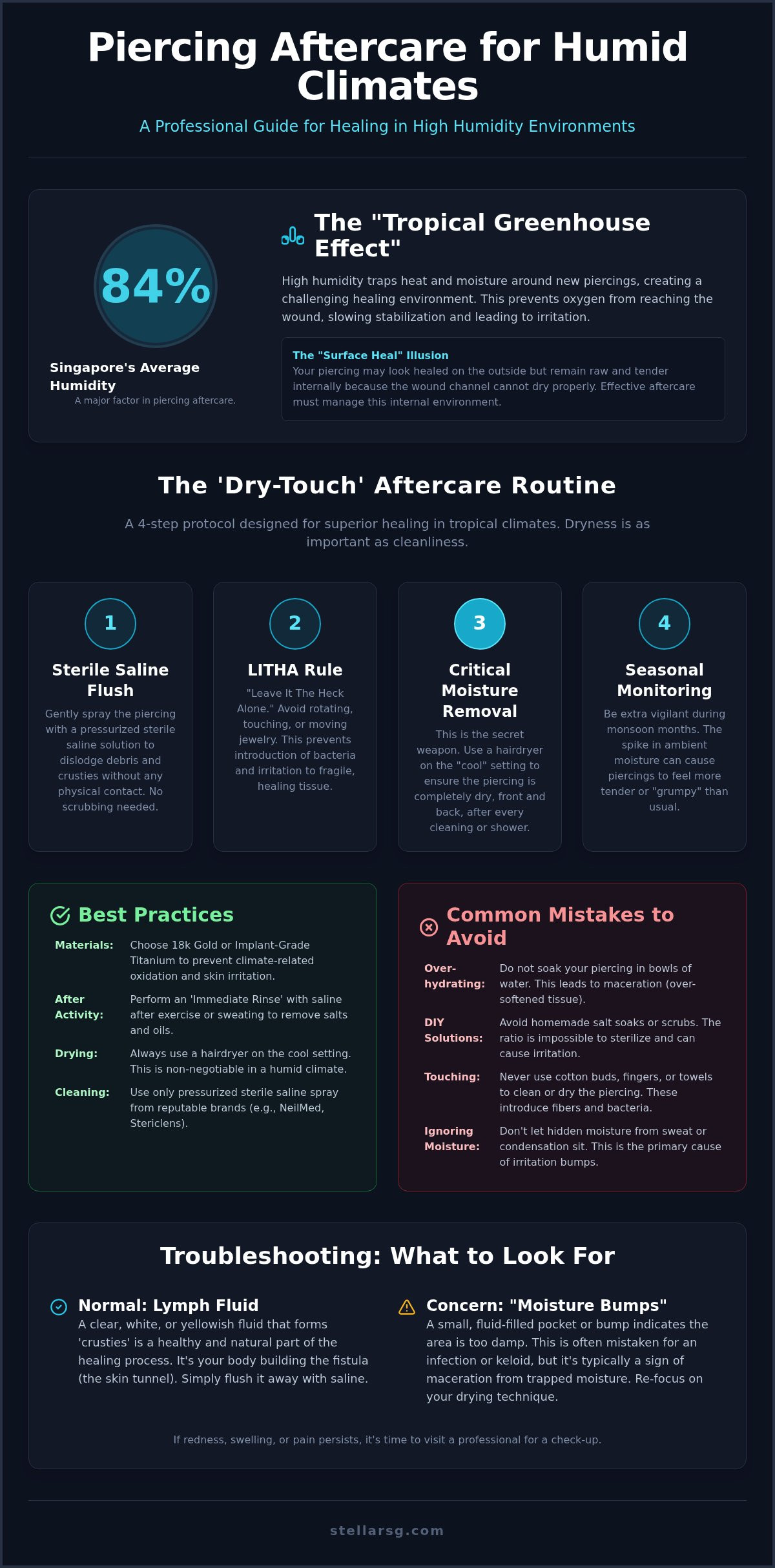
In Singapore's 84% humidity, the traditional advice of just "keeping it clean" is often the very thing slowing down your recovery. Mastering piercing aftercare for humid climates requires a sophisticated shift from simple cleaning to professional moisture management. When the air is thick and the tropical heat is constant, your skin needs a specialized protocol to ensure your new aesthetic investment heals with the elegance and ease it deserves.
It's understandable to feel concerned when a piercing remains persistently red or itchy long after the initial appointment. You might find yourself confused by the presence of lymph fluid, wondering if it's a sign of a deeper issue or just a natural part of the process. We're here to provide the clarity you need. By following our expert 'Clean & Dry' protocol, you'll gain total confidence in identifying each stage of the healing journey. This guide delivers a precise routine to manage moisture and provides clear instructions on when it's finally safe to resume your favorite exercise or take a dip in the pool.
Living in Singapore means embracing a climate that is perpetually lush and tropical. While this 84% humidity is wonderful for your skin's glow, it creates a unique set of challenges for the Body piercing healing process. Standard advice often fails to account for the "tropical greenhouse effect." This phenomenon occurs when air moisture and sweat combine to trap heat around your new jewelry, preventing the site from receiving the oxygen it needs to stabilize. It's not just about cleanliness; it's about managing the invisible environment surrounding your skin.
A common frustration for many in Singapore is the "surface heal." Your piercing might look perfect in a mirror, yet remain tender and raw internally. This happens because high humidity slows down the drying of the internal wound. Constant sweating also shifts your skin's natural pH, which can destabilize the delicate balance required for long-term comfort. Effective piercing aftercare for humid climates focuses on managing this internal environment, ensuring the jewelry sits in a stable, dry channel rather than a damp, irritated one.
Moisture irritation is frequently mistaken for an infection or a keloid. When excess fluid stays in contact with the skin, it leads to maceration, a process where the healing tissue softens and becomes fragile. This often manifests as a "moisture bump," a small, fluid-filled pocket that indicates the area is too damp. A fistula is the internal skin tunnel that requires a consistently dry environment to stabilize and mature. If you are concerned about a persistent bump, our team at our piercing service locations can provide a professional assessment to ensure your path to healing remains on track.
The urban landscape of Singapore presents a specific environmental hurdle: the constant transition between high-blast air conditioning and 32-degree outdoor heat. This rapid temperature swing causes micro-condensation to form on metal surfaces, including your jewelry. This hidden moisture becomes trapped between the skin and the earring, especially in "moisture traps" like the back of the earlobe or the folds of a helix piercing. Piercing aftercare for humid climates must account for these invisible droplets that accumulate throughout a typical day in the city. Without proactive drying, these traps become a breeding ground for bacteria, regardless of how often you use a saline spray.
In a city where the air often feels like a warm blanket, traditional cleaning methods can fall short. Mastering piercing aftercare for humid climates involves more than just a quick rinse. It requires a sophisticated approach that prioritizes dryness just as much as cleanliness. Our 'Dry-Touch' routine is designed to navigate Singapore's environmental challenges while maintaining the elegance of your new jewelry.
It's a common mistake to think that more liquid equals a cleaner piercing. In reality, over-hydrating the skin can lead to maceration, where the tissue stays too soft to heal properly. Avoid soaking your piercing in bowls of water. Instead, stick to targeted spraying. We also advise against homemade salt scrubs. The humidity in Singapore can cause salt to clump, and it's nearly impossible to get the ratio sterile at home. For the best results, use reputable sterile saline brands like NeilMed or Stericlens, which are easily found in local pharmacies. If you're unsure about your current routine, you can always book an appointment for a professional check-up at one of our studios.
The real secret to successful healing in the tropics is the drying phase. Many enthusiasts use a hairdryer on the "cool" setting to ensure their piercing is bone-dry. Direct the airflow toward the front and back of the site for thirty seconds after every cleaning. This prevents the "moisture traps" mentioned in previous sections from forming. Do not use cotton buds; their tiny fibers can snag on jewelry and trap bacteria against the wound. Instead, use non-woven sterile gauze. Use the 'Gauze Dab' method by gently pressing the edge of the gauze against the base of the jewelry to wick away moisture without moving the post. This keeps the environment stable and the skin calm.
Your choice of jewelry is the foundation of a successful healing journey. In an environment where moisture is constant, the wrong metal can quickly lead to irritation or permanent skin staining. High-quality materials are the cornerstone of effective piercing aftercare for humid climates. While fashion jewelry might be tempting for its price, it often contains base metals that react poorly to Singapore's heat.
Fashion jewelry and sterling silver are prone to rapid oxidation in high humidity. This reaction often leaves a dark green or black residue on the skin, which can be difficult to remove and irritating to a fresh wound. Implant-grade titanium and 18k gold are bio-compatible and inert. They don't react to the salts and minerals found in human sweat. This stability is essential for maintaining a calm, healthy piercing site while ensuring your jewelry remains as brilliant as the day it was fitted.
We also account for "humidity swelling." Tropical heat often causes the body to retain more fluid, leading to slight fluctuations in skin thickness. Using a post with a bit of extra length is a professional necessity in Singapore. It prevents the jewelry from embedding or putting undue pressure on the fistula. This extra space allows for much-needed airflow, which is the primary defense against moisture-related complications in our 84% humidity.
Solid 18k gold is the gold standard for a reason. Its high purity means it won't flake, peel, or tarnish when exposed to the elements. This ensures your jewelry maintains its luster despite daily showers, gym sessions, and outdoor activity. It's an investment in both your personal style and your physical comfort. For more details on making the right choice for your anatomy, check out our guide on 18k gold piercing earrings.
Traditional butterfly backs are problematic in the tropics. Their design creates a "moisture trap" where sweat, oils, and hair products accumulate. These loops are nearly impossible to dry thoroughly, making them magnets for bacteria. A flat-back labret is a much more elegant and hygienic solution. It sits flush against the skin, allowing for better air circulation around the wound. Internally threaded jewelry is also safer for the initial piercing. The smooth post passes through the skin without causing the micro-tears associated with cheaper, externally threaded alternatives. This methodical attention to detail ensures a smoother recovery and a more refined aesthetic.
Maintaining an active lifestyle in Singapore is a priority for many, but it requires a strategic approach for new jewelry. Whether you're running along the Marina or attending a high-intensity pilates session, sweat is an unavoidable factor. In our 84% humidity, perspiration doesn't evaporate quickly. It lingers. This makes piercing aftercare for humid climates a dynamic process that goes beyond a simple morning and evening routine.
Our 'Immediate Rinse' protocol is your best defense. The second you finish a workout, the salts and minerals in your sweat begin to crystallize. These crystals can act like sandpaper against a healing fistula, causing micro-tears and irritation. We recommend a quick saline flush immediately after your heart rate drops. This keeps the area pristine and prevents the "grumpy" piercing feeling that often follows a heavy gym session. Don't wait until you get home; a portable saline spray is an essential gym bag companion.
Be mindful of your hair styling and outdoor products. A tight "post-gym bun" might be convenient, but it often traps damp, sweat-soaked strands directly against a helix or flat piercing. This creates a miniature greenhouse that encourages bacterial growth. Similarly, sunblock and tanning oils are essential for Singapore's sun, but they shouldn't touch your jewelry. These products are often thick and comedogenic. They can easily clog the piercing site and trap bacteria inside the wound. Apply your SPF carefully, leaving a small safety zone around your new adornment.
The 5-minute rule is a game-changer for active individuals. Flushing the site within five minutes of finishing exercise prevents salt from drying and crusting. While sweatbands are popular for keeping hair back, they can be a double-edged sword. If they sit directly over a piercing, they become a moisture trap that presses bacteria into the skin. It's better to use clips or pins to secure hair without covering the jewelry. Always integrate your piercing care as the final step of your post-workout shower. This ensures any shampoo or hair product residue is completely washed away before you begin the drying process.
Swimming is a central part of Singaporean life, yet it poses a significant risk to a fresh piercing. We recommend waiting at least 4 to 6 weeks before any pool immersion. Private condominiums and public pools use chlorine that can be incredibly drying and irritating to raw tissue. The sea at East Coast Park or Sentosa introduces unpredictable bacteria and debris into the wound. For a comprehensive look at how to return to the water safely, check out our 2026 swimming aftercare checklist. Watertight bandages are often marketed as a solution, but they rarely provide a true seal on the complex anatomy of the ear. If you have any doubts about your healing progress, book an appointment at one of our studios for a professional check-up before you dive in.
Confidence in your healing journey comes from knowing exactly what to expect as your body adapts. Even with a meticulous routine for piercing aftercare for humid climates, it's natural to have questions about the sensations you experience. Our commitment to your safety doesn't end once you leave the studio. Our professional piercing service includes dedicated post-care support to ensure your aesthetic investment remains healthy and beautiful.
Distinguishing between normal healing and a potential issue is a vital skill. Most clients will notice "lymph fluid" during the first few weeks. This is a thin, clear, or pale yellow substance that dries into "crusties" around the jewelry. This is a sign of a healthy immune response. In contrast, concerning discharge is typically thick, opaque, and may be green or dark yellow. If you notice an unpleasant odor or if the discharge is accompanied by a persistent "Redness Test" failure, it's time for a professional assessment. The Redness Test is simple: if the area feels hot to the touch, looks significantly swollen, and the redness is spreading away from the site, you should visit us immediately.
In Singapore's heat, minor swelling is often just a reaction to the climate rather than a sign of a deeper issue. If your piercing feels tight due to outdoor heat, try the 'Cold Compress' trick. Wrap a clean, cold pack in a fresh paper towel and hold it near the area for five minutes to constrict blood vessels and soothe the skin. However, if you experience throbbing pain, fever, or see pus, these are signs of a possible infection. Never remove the jewelry yourself if you suspect an infection. Removing the stud can cause the skin to close over the wound, trapping the bacteria inside. Instead, keep the area clean and let our expert piercers guide you on the next steps.
Downsizing is arguably the most neglected step in Singaporean aftercare. When you're first pierced, we use a longer "starter bar" to accommodate initial tropical swelling. Once that swelling subsides, usually after 4 to 8 weeks, that extra length becomes a liability. A bar that is too long will slide back and forth, causing friction and trapping more moisture against the fistula. This often leads to "piercing tilt," where the jewelry begins to sit at an unattractive angle. Shortening the post ensures the jewelry sits flush, stays dry, and remains stable. Ready for your check-up? You can book your appointment at any Stellar SG location to have your jewelry professionally fitted for the next stage of your healing.
We're here to support you at every stage of your recovery. With over eight locations across Singapore, our studios provide medical-grade sterilization standards and an exquisite selection of 18k gold jewelry. Our expert team is dedicated to providing the professional guidance you need for a seamless and elegant experience. We'll help you navigate the tropical humidity with confidence and ease.
Book Your Professional Piercing Experience at Stellar SG and start your journey with the care you deserve. Your vibrant new look is waiting.
Healing in Singapore requires more attention to moisture management than in drier climates. While the 84% humidity doesn't make healing impossible, it does slow down the internal stabilization of the wound. Without proper piercing aftercare for humid climates, moisture can linger, leading to irritation. Following a dedicated "Dry-Touch" routine ensures your piercing remains healthy despite the tropical greenhouse effect. It's about being proactive with your skin's unique needs.
Using a hairdryer on a cool, low-pressure setting is highly recommended for residents in tropical regions. It's the most effective way to ensure the back of the jewelry and the skin folds are completely dry. This prevents the "moisture traps" that often lead to irritation bumps. Hold the dryer at arm's length and move it gently around the ear for thirty seconds after every cleaning or shower.
The best way to stop sweat-related itching is to perform an immediate saline rinse after any activity. Itching is usually caused by salt crystals from your perspiration drying on the sensitive healing tissue. By flushing the area with sterile saline within five minutes of finishing your workout, you remove these irritants before they can cause discomfort. This simple step keeps the skin calm and the healing process on track.
If you're caught in a sudden Singaporean downpour, treat the area as soon as you get indoors. Rainwater can carry urban pollutants and bacteria that shouldn't sit on a fresh wound. Gently flush the piercing with sterile saline to remove any environmental debris. Afterward, use the "Gauze Dab" method or a cool hairdryer to ensure the site is bone-dry. This proactive approach prevents moisture-related complications from developing.
We suggest waiting at least 4 to 6 weeks after your appointment before heading to the beach. Fresh piercings are open wounds that are highly susceptible to the bacteria found in seawater and sand. Additionally, the heat and sunblock required for a beach day can further irritate a new site. For the most elegant and stress-free healing experience, schedule your piercing well in advance of any planned tropical getaways.
Even if you spend your day in a climate-controlled office, you should still clean your piercing twice daily. Moving between the cold AC and the outdoor heat causes micro-condensation to form on your jewelry. This hidden moisture needs to be managed just as carefully as sweat. A morning and evening routine using sterile saline and thorough drying will keep the environment stable and prevent any "grumpy" piercing symptoms.
Increased "crusties" in hot weather are usually a result of sweat mixing with natural lymph fluid. In Singapore's heat, these fluids can dry more rapidly on the surface of the skin, forming a protective but sometimes uncomfortable layer. Don't pick at these crusts with your fingers. Instead, use a pressurized saline spray to soften and wash them away gently. This maintains the integrity of the healing tissue without causing unnecessary friction.
Switch to smaller earrings, or "downsize," typically 4 to 8 weeks after your initial service. In a humid environment, this step is vital because it reduces the jewelry's movement and prevents moisture from being trapped by a long post. Piercing aftercare for humid climates relies on this professional adjustment to ensure the jewelry sits flush. Always visit a professional to handle this transition to avoid irritating the maturing fistula.


