 欧元、澳元、英镑、日元、印度卢比


全部的: $0.00
结账时计算税费和运费
 SGD
SGD


Is that stunning new earring a permanent style statement or a hidden source of irritation? Many people assume that higher gold purity automatically guarantees a better healing experience, but the reality of 14k vs 18k gold for piercings is more nuanced than a simple price tag. You want jewelry that reflects your sophisticated taste without compromising your skin's health. It's completely natural to feel concerned about potential nickel allergies or whether a luxury investment might tarnish or break with daily wear.
We believe your piercing journey deserves the highest level of specialized care and aesthetic refinement. You'll discover the critical differences between these two gold standards to ensure your new piercing heals beautifully and stays timelessly elegant. This guide explores the science of biocompatibility and the practical durability of each alloy, helping you choose the perfect karat for your lifestyle. We will compare the 58.3 percent purity of 14k gold against the 75 percent purity of 18k gold to find your ideal match. By the end, you'll feel confident selecting jewelry that supports fast healing and offers the lasting satisfaction you deserve.
Choosing the right jewelry starts with a simple fraction. In the world of fine jewelry, "karat" measures gold purity based on a scale of 24 parts. Pure gold, or 24k, is an elemental marvel, but it's far too soft for the structural demands of a new piercing. It bends and scratches with the slightest pressure. These tiny imperfections can harbor bacteria, creating a risk for healing wounds. To solve this, master crafters mix pure gold with stronger metals like copper, silver, or zinc. This process of Understanding Gold Karatage allows us to create beautiful, resilient pieces that stand the test of time. Finding the right balance in the 14k vs 18k gold for piercings debate depends on your skin's needs and your personal style.
Deciding on 14k vs 18k gold for piercings means choosing a balance between purity and structural integrity. Both are "solid gold," meaning they aren't just plated with a thin layer that wears away. They're consistent alloys, ensuring your investment remains stunning. This internal strength is vital for jewelry that stays in your body 24/7 during the initial healing phase.
14k gold consists of 14 parts gold and 10 parts alloy, resulting in approximately 58.3% purity. It's a popular choice for those who lead highly active lifestyles. Because it contains a higher percentage of base metals, it's exceptionally resistant to scratches and dents. Visually, 14k gold often appears slightly paler in tone compared to higher-karat pieces. It offers a practical entry point into luxury jewelry while maintaining the "solid gold" promise.
18k gold is our "Stellar Standard" for a reason. Composed of 18 parts gold and 6 parts alloy, it reaches 75% purity. This higher gold content produces a rich, warm glow. Beyond its aesthetic brilliance, 18k gold is significantly more biocompatible. Fewer base metals mean a lower chance of skin sensitivities. Our piercing service exclusively uses these premium materials to ensure your experience is as safe as it is beautiful.
When choosing between 14k vs 18k gold for piercings, the first thing you'll notice is the visual presence. 18k gold possesses a deep, saturated luster that 14k simply cannot replicate. This is due to its 75 percent gold content, which gives the metal a distinct, buttery warmth. In contrast, 14k gold has a more subtle, paler yellow tone. While some prefer this muted look for a minimalist aesthetic, 18k gold is widely viewed as the pinnacle of luxury in fine jewelry.
The rich warmth of 18k gold is exceptionally versatile. It complements a wide range of skin tones, from cool porcelain to deep olive, by adding a radiant glow to the face. If you prefer a cooler palette, you might consider how different alloys affect the final look. For instance, White Gold Stud Earrings Singapore offer a sophisticated, silvery alternative that still maintains the prestige of solid gold. 14k gold remains a classic choice for those who want a more understated, champagne-colored finish.
A common misconception suggests that 18k gold is "too soft" for everyday use. While 24k gold is indeed impractical, 18k gold is perfectly suited for ear piercings. It easily meets the Association of Professional Piercers' standards for safety and durability. While 14k gold is often preferred for high-impact jewelry like rings that might knock against hard surfaces, your ears are a low-impact area. For these piercings, the biocompatibility of 18k gold far outweighs the marginal hardness of 14k. We ensure every piece features secure backings, providing peace of mind that your luxury investment stays exactly where it belongs. If you're ready to find a piece that balances this beauty with long-term safety, you can book an appointment to view our curated collection in person.
Biocompatibility is the ability of a material to perform with an appropriate host response in a specific situation. When you receive a new piercing, your body treats the jewelry as a foreign object within a fresh wound. For a successful and comfortable outcome, you need a metal that doesn't trigger a defensive or allergic reaction. This is where the 14k vs 18k gold for piercings debate moves beyond aesthetics and into the territory of physical health. High-purity gold is remarkably inert, meaning it's less likely to cause the swelling, itching, or weeping that often plagues lower-quality metals.
The primary culprit for ear irritation is nickel. Many manufacturers use nickel in gold alloys to increase hardness or alter the metal's color. According to the U.S. Geological Survey definition of gold alloys, 18k gold contains 75 percent pure gold, leaving only 25 percent for other metals. In contrast, 14k gold is approximately 58.3 percent pure. That extra 16.7 percent of alloy in 14k pieces often contains higher concentrations of base metals that can irritate sensitive tissue. For those with a history of metal sensitivity, this percentage gap is the difference between a piercing that heals and one that remains perpetually inflamed.
It's also vital to distinguish solid gold from gold-plated alternatives. Plating is merely a microscopic layer of gold over a base metal like brass or copper. During the healing process, the constant contact with skin oils, sweat, and saline cleaning solutions can wear this layer down. Once the base metal is exposed, it can leach irritants directly into your open wound. This often leads to persistent redness or even the body rejecting the piercing entirely. Choosing solid gold ensures that what touches your internal tissue is consistent, safe, and high-quality from the surface to the core.
Living in a tropical climate adds a layer of complexity to piercing care. Singapore's intense humidity and heat mean you're likely to sweat more, which can accelerate the oxidation of low-quality alloys. When sweat reacts with certain base metals, it can create the dreaded "green ear" effect or localized rashes. This is a major reason why gold-plated earrings cause irritation so frequently in our local environment. Solid 18k gold remains stable and skin-friendly, even on the most humid days at the beach or in the city.
The first six weeks represent the most critical phase for any new ear piercing. During this time, the tissue is forming a "fistula," or skin tunnel, around the jewelry post. Using 18k gold minimizes the risk of rejection because the high purity supports a calm host response. While you might eventually wear 14k gold once the site is fully matured and toughened, starting with the "Stellar Standard" of 18k protects your skin's long-term integrity. It's about giving your body the best possible environment to recover without unnecessary chemical stress.
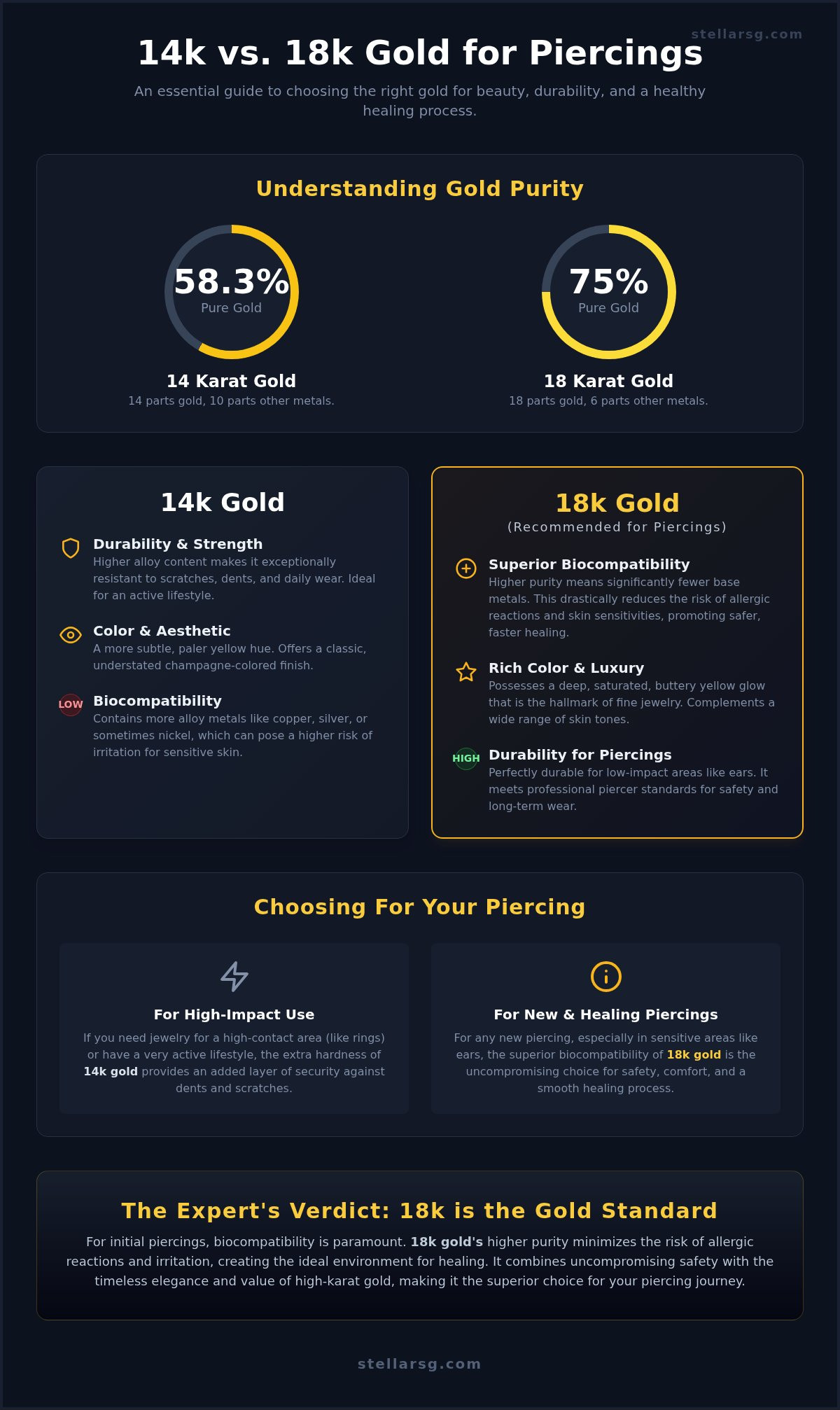
Your daily routine plays a significant role in determining the best 14k vs 18k gold for piercings choice. While hardness is a major factor for rings that strike hard surfaces, ear piercings are relatively protected. This means the slight softness of 18k gold is rarely a drawback for your ears. If you're an avid swimmer or frequently wear heavy helmets for cycling, you might prioritize the added alloy strength of 14k gold. However, for most luxury seekers, the superior purity of 18k gold offers a lifetime of elegant wear without the risk of skin fatigue.
The location of your piercing also dictates the material. Lobes typically heal faster and are more resilient. Cartilage piercings, such as the helix or conch, are notoriously temperamental and take longer to stabilize. For these delicate areas, we always recommend 18k gold. Its higher purity reduces the chemical stress on the healing tissue, leading to a smoother recovery. This is especially true for children or first-time piercers. We advocate for the "Stellar Standard" of 18k gold to provide the gentlest possible introduction to ear styling.
Maintaining the brilliance of your jewelry in Singapore's tropical climate requires a proactive approach. High humidity and salt air can eventually dull the finish of lower-karat alloys. 18k gold is naturally more resistant to this environmental tarnishing, staying bright and radiant with minimal effort. To keep your collection in pristine condition, you can follow our expert tips on how to clean stud earrings. Regular, gentle care ensures that the deep luster of your gold remains a standout feature of your look.
Creating a "curated ear" often involves mixing different textures and tones. You don't have to stick to just one karat. Many of our clients blend 14k gold for their everyday "filler" studs while reserving 18k gold for their statement pieces. This high-low mix adds depth to your aesthetic. For a truly timeless appearance, nothing compares to the fire of Diamond Stud Earrings Singapore paired with a warm 18k gold setting. This combination bridges the gap between modern trend and classic investment.
Ready to elevate your jewelry collection with pieces designed for both safety and sophistication? You can book an appointment at one of our central Singapore locations to find your perfect match.
Choosing between 14k vs 18k gold for piercings is about more than just a number; it's about the standard of care you deserve. At Stellar SG, we exclusively advocate for 18k solid gold because it represents the perfect intersection of biocompatibility and enduring beauty. Our curated collection is designed for those who refuse to compromise on their health or their style. When you visit our studios, you're not just purchasing jewelry. You're entering a space where medical-grade safety meets a high-end boutique experience.
Your journey begins with a personalized consultation. Our experts guide you through our selection of 18k gold pieces, ensuring your choice aligns with your anatomy and your aesthetic goals. We prioritize transparency and education, helping you understand why high-purity gold is the most responsible choice for a new piercing. From our rigorous sterilization protocols to our methodical approach to jewelry selection, every detail is handled with specialized care. We believe that the right material, paired with expert technique, creates the foundation for a lifetime of confidence.
Precision and comfort are the hallmarks of our Stellar SG Piercing Service. Our piercers are specifically trained to work with sensitive ears and children, providing a gentle experience that emphasizes physical ease. We operate in a luxury environment that adheres to strict medical hygiene standards. This blend of professional skill and premium materials ensures your piercing heals as beautifully as it looks on day one. You don't have to choose between safety and style; we provide both in every session.
Finding the right expert shouldn't be difficult. We offer accessible luxury at central Singapore locations, including ION Orchard and VivoCity. Our team is ready to provide the attentive, knowledgeable service you expect from a high-end boutique. Book your professional piercing appointment today to begin your styling journey with us. Investing in 18k gold is more than a purchase; it's an investment in your own elegant journey and long-term well-being.
Choosing between 14k vs 18k gold for piercings is the first step toward a lifetime of elegant self-expression. You now understand that while 14k gold offers durability, the 75 percent purity of 18k gold provides the ultimate environment for a healthy, irritant-free healing process. This higher gold content isn't just about the deep, radiant luster; it's a commitment to your skin's long-term comfort, especially in Singapore's humid climate.
At Stellar SG, we combine our exquisite 18k solid gold jewelry collection with medical-grade sterilization standards to ensure your safety. As Singapore's leading experts in sensitive ear piercings, we're dedicated to making your experience as comfortable as it is sophisticated. Don't settle for anything less than the brilliance and biocompatibility your body deserves. Book your expert 18k gold piercing appointment at Stellar SG today and enjoy the confidence of a perfectly healed, timelessly beautiful piercing. We look forward to welcoming you to our boutique soon.
18k gold is the superior choice for first-time piercings due to its 75 percent purity. This high gold content supports a calmer healing response compared to lower karats. When evaluating 14k vs 18k gold for piercings, 18k provides a safer, more luxurious introduction for your skin. It minimizes the risk of early-stage irritation and ensures your styling journey begins with total confidence.
While 18k gold is highly biocompatible, reactions can occur if the alloy contains nickel or excessive copper. We curate our 18k collection to meet strict safety standards, minimizing these risks for our clients. If you have extreme sensitivities, our expert piercers can help you select the most inert options available. This professional guidance ensures your luxury jewelry remains comfortable for daily wear.
Authentic gold jewelry features specific stamps or hallmarks to verify its purity level. You should look for a "750" stamp on 18k pieces and a "585" stamp on 14k pieces. Purchasing from a trusted boutique like Stellar SG ensures your jewelry is genuine solid gold rather than a plated alternative. We provide full transparency regarding the materials used in every piece we offer.
18k gold is not too soft for cartilage piercings. Although it contains more pure gold than 14k, it remains structurally sound for the ear's low-impact environment. It offers the perfect balance of prestige and durability for delicate placements like the helix or tragus. You get the benefit of higher purity without sacrificing the security of your jewelry's intricate design.
Yes, 14k gold can tarnish more quickly in Singapore's humidity because it contains a higher percentage of base metal alloys. These metals react with sweat and moisture over time, leading to a duller appearance. 18k gold stays radiant longer because it's more chemically stable. It's an ideal choice for the local tropical climate, requiring less frequent deep cleaning to maintain its glow.
The investment in 18k gold is worthwhile because it offers better skin protection and higher intrinsic value. When comparing 14k vs 18k gold for piercings, the 18k option provides a richer color and greater peace of mind for sensitive ears. It's a premium choice that retains its beauty for a lifetime. You're paying for both the aesthetic brilliance and the long-term health of your piercing.
We don't recommend 14k gold for fresh piercings if you have a history of sensitive skin. The 10 parts of alloy in 14k gold are more likely to trigger redness or itching during the critical healing phase. Sticking to 18k gold ensures your body can focus on recovery without chemical interference. Once the piercing is fully matured, you'll have more flexibility with different gold karats.
The best way to clean 18k gold is with mild, fragrance-free soap and warm water. Use a soft brush to reach intricate details, then gently pat the jewelry dry with a lint-free cloth to maintain its brilliant luster. Avoid harsh chemicals or abrasive cleaners, as these can damage the refined finish of your luxury pieces. Regular, gentle maintenance keeps your gold looking as stunning as the day you bought it.


