 SGD
SGD EUR
EUR
 AUD
AUD
 GBP
GBP
 JPY
JPY
 INR
INR
Total: $0.00
Taxes and shipping calculated at checkout


Last Tuesday, Chloe looked in the mirror, tired of the plain starter studs she's worn since her piercing appointment three weeks ago. Like many stylish individuals in Singapore, she's caught between the excitement of an elegant new look and the fear of her piercing closing up or reacting to the relentless 85% humidity. You likely feel the same mix of impatience and caution while scrolling through conflicting advice online.
It's completely natural to crave a change from those basic medical-grade studs, but you want to ensure your skin is truly ready before making the switch. This 2026 guide reveals the exact biological signs and expert-approved timelines to help you decide exactly when to change ear piercing stud sets without the risk of infection or the pain of a re-piercing. We'll explore the critical healing milestones, the best premium materials for your next pair, and how to transition to your new style with absolute confidence.
Your new piercing is more than just a stylish addition; it's a wound that requires expert care and patience. To understand when to change ear piercing stud sets, you must first understand the fistula. This is the delicate tunnel of skin that forms through your ear tissue. According to Understanding Body Piercing, the body reacts to jewelry as a foreign object, eventually lining the path with new skin cells. This process requires precision and time to ensure a lifetime of elegant ear styling.
Initial jewelry isn't just about aesthetics; it's designed for safety and recovery. Professional starter studs feature longer posts to accommodate the natural swelling that occurs in the first 72 hours. We use premium, hypoallergenic materials like medical-grade titanium or 14K gold to prevent allergic reactions. These materials are essential for those with sensitive skin who want a confident, irritation-free experience. Knowing when to change ear piercing stud options depends entirely on how well these materials allow the fistula to mature. Butterfly backs are often avoided for initial cartilage healing because they trap moisture and bacteria against the wound. Our skilled staff ensures you start your journey with the best possible hardware for a safe, stylish result.
Knowing exactly when to change ear piercing stud sets is the difference between a lifetime of style and a month of medical frustration. The location of your jewelry is the most critical factor in this decision. Healing isn't a linear process; it's a biological journey that moves at different speeds depending on blood flow and tissue density. In Singapore, our unique environment plays a significant role. With average humidity levels often exceeding 80 percent, sweat and moisture can trap bacteria, which prolongs the initial inflammatory phase. This means local experts often recommend a slightly more conservative timeline than those in drier climates.
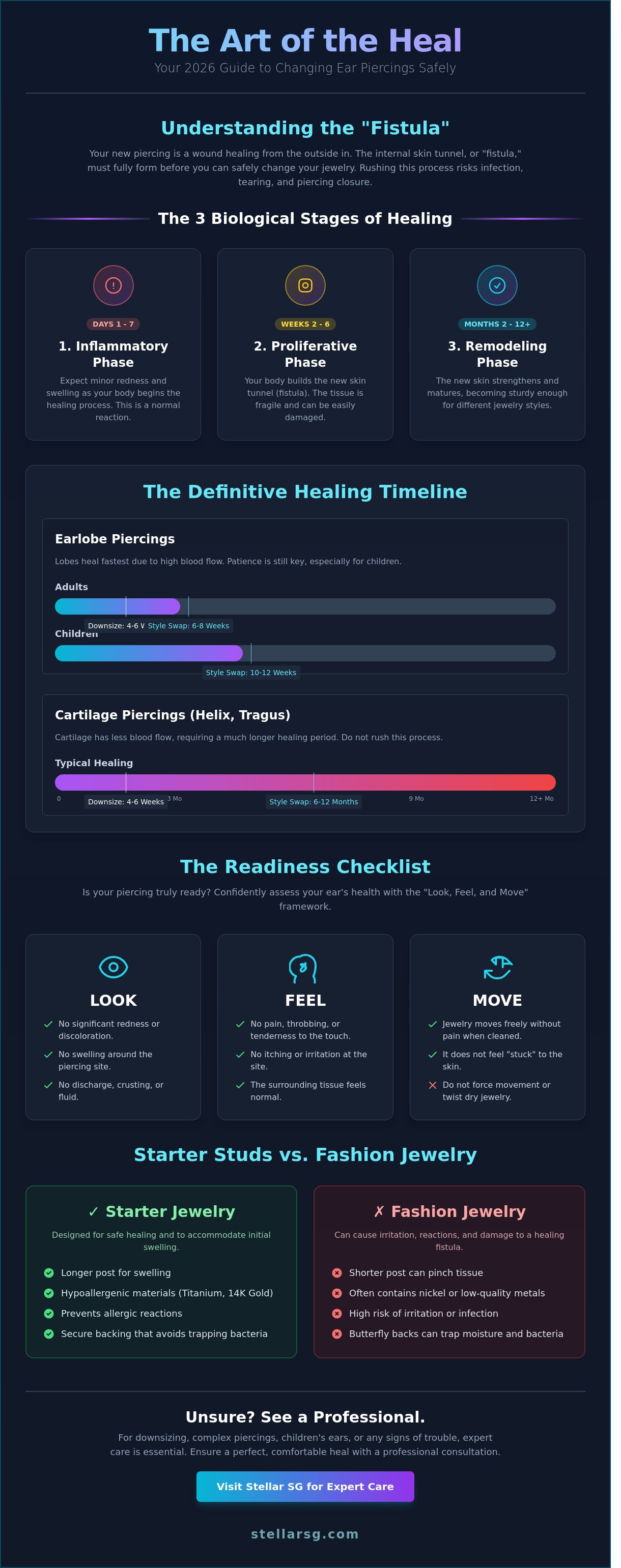
You must distinguish between the Downsize Window and the Style Swap Window. Downsizing usually happens at 4 to 6 weeks. This involves a professional replacing your long initial post with a shorter one to prevent the jewelry from snagging or tilting. The Style Swap, where you choose a new aesthetic, should only happen once the internal tunnel of skin, called the fistula, is fully matured. Prioritizing your ear's health over a fleeting social media trend ensures your piercing remains beautiful for years.
Lobe piercings are the most common because they heal efficiently. The high concentration of blood vessels in the earlobe delivers the oxygen and nutrients required for rapid tissue repair. Most adults can consider a style change at the 6 to 8 week mark. However, don't leave the piercing empty. At this stage, a lobe piercing can shrink or close in less than 60 minutes. For children, we recommend waiting a full 10 to 12 weeks. Their active lifestyles and developing immune systems benefit from the extra stability. If you're unsure, our professional piercing service can assess the site for you.
Cartilage is different from lobe tissue because it lacks its own blood supply. This structural reality extends the healing timeline significantly. For 2026 trending placements like the Conch or the Flat, patience is mandatory. Changing a helix stud before the 6 month mark often triggers a piercing bump, a localized irritation caused by premature friction on the delicate fistula. These bumps can take months to resolve and may lead to permanent scarring if ignored.
When you feel ready for a new look, it's safest to book an appointment to have a specialist perform the first change. This ensures your new jewelry is sterile and correctly fitted to your unique anatomy.
Determining when to change ear piercing stud sets the foundation for a lifetime of healthy, stylish ears. While professional guidelines provide a general timeline, your body follows its own recovery pace. Passing the calendar date is only half the battle; the other half is a physical assessment. We recommend using the Look, Feel, and Move framework to ensure your skin is resilient enough for a jewelry swap. Comparing your progress against the standard piercing healing process helps you decide if you're ahead of schedule or need more time.
Don't rush the process if you notice any red flags. If your ear feels hot to the touch, shows significant swelling, or secretes thick yellow fluid, your piercing isn't ready. Changing jewelry during an active inflammatory phase can cause the delicate new tissue to collapse or scar. Patience ensures your style transition is as elegant as the jewelry you've chosen.
Your first check is purely visual. Your skin provides clear signals when the internal tunnel, known as the fistula, has reached a stable state. Follow these three benchmarks:
Before you commit to a new look, perform a gentle movement test. Wash your hands thoroughly with antimicrobial soap first. Gently take hold of the stud and check for "play" by moving it slightly forward and backward. Do not rotate the jewelry, as this can tear the fragile new skin cells inside the hole.
A healed fistula feels loose and allows the jewelry to slide effortlessly, while an unhealed one feels sticky or tight against the metal. This "sticky" sensation is a sign that the skin is still adhering to the post. If you fail this test or feel even a tiny pinch of discomfort, stop immediately. Follow the 14-day wait-and-see protocol. Give your ears 2 full weeks of uninterrupted rest before testing again. This cautious approach is the best way to determine when to change ear piercing stud without risking a setback in your healing journey.
The first time you transition from your starter studs is a defining moment for your piercing's longevity. This initial swap is the most critical step in maintaining a healthy, open hole. If you rush the process or use inferior materials, you risk irritation or immediate closure. Before you begin, gather your essentials: sterile saline solution, a clean mirror, and buying elegant earrings in Singapore that feature premium, hypoallergenic materials like 14K gold or titanium.
Always follow the 24-Hour Rule. Once you successfully insert your new jewelry, keep it in place for at least 24 hours without removal. This stability allows the delicate, newly formed skin to adjust to the different post thickness or weight. Understanding when to change ear piercing stud and how to do it safely sets the foundation for a lifetime of stylish accessorizing.
Begin by washing your hands thoroughly with antimicrobial soap for at least 20 seconds. Create a "safe zone" by plugging your sink or laying down a clean white towel. This prevents losing small backs or premium gems down the drain. Disinfect your new jewelry using sterile saline solution. Don't use tap water, as it may contain trace bacteria that lead to infections. Avoid rubbing alcohol for this first change; it's often too aggressive for the sensitive tissue and can cause painful dryness.
The technique depends on your jewelry type. For threadless studs, pull the two pieces apart firmly. For threaded options, unscrew the decorative top gently. If you have traditional butterfly backs, stabilize the front of the stud while pulling the back away. Finding the "exit hole" can be tricky the first time. Use a well-lit mirror and guide the new post at a straight angle. If you feel resistance, don't force the metal through. Instead, apply a drop of saline for lubrication.
Follow the "Immediate Replacement" rule. Don't leave the piercing empty for more than 5 minutes. Even after the initial healing period, a new hole can begin to shrink or close within moments. Keeping jewelry in the canal at all times during the first few months is essential for a permanent result.
While changing a lobe piercing at home might seem simple, certain scenarios require an expert hand. High cartilage piercings, such as the helix, tragus, or conch, involve denser tissue that heals much slower than the soft lobe. Attempting a DIY change in these areas often leads to micro-tears or the introduction of bacteria into a still-vulnerable site. For children, the first change is a delicate milestone. Our specialists at Stellar SG create a calm, sterile environment to ensure this transition is entirely painless. Knowing when to change ear piercing stud sets the foundation for a lifetime of healthy ears, and often that decision is best made by a professional eye.
A professional change at one of our 8 Singapore boutiques offers more than just a new look. We prioritize the structural integrity of your piercing. Our team uses sterile, medical-grade tools and tapered insertion pins. These specialized pins guide the new jewelry into the piercing channel seamlessly. This eliminates the "fishing" motion that causes trauma and irritation when you try to find the exit hole yourself.
Our staff takes the time to measure the thickness of your ear. This ensures the post length is perfect for your unique anatomy. A post that's too short can pinch the tissue, while one that's too long will tilt and cause "piercing bumps." We take the guesswork out of the equation so you can enjoy your new style with total confidence.
Ready for a refresh? Don't risk the health of your new piercing by rushing the process at home. Visit us for a professional check-up and a seamless transition to your next favorite piece. Our skilled staff ensures a safe procedure in a welcoming environment, maintaining the high standards Stellar SG is known for across Singapore.
Whether you're looking for a sparkling diamond upgrade or a minimalist gold stud, we're here to help you transition safely. You can book an appointment at any of our 8 convenient locations today. We're committed to making your jewelry journey as elegant and safe as the very first day you got pierced. Trust the experts to handle the details while you focus on your new look.
When you've reached that healing milestone, choose the peace of mind that comes with expert care. Our skilled staff at Stellar SG are trained in sterile procedures to make your first transition effortless and comfortable. You can explore our premium collection of 14K Gold and medical-grade Titanium pieces at any of our 8 convenient locations across Singapore shopping malls. We prioritize your safety so you can focus on finding your next favorite look.
Book your professional jewelry change and styling session at Stellar SG to step into your new aesthetic with total confidence.
Changing your studs after only 2 weeks risks immediate closure and infection because the wound is still raw. Most lobe piercings require at least 6 weeks to form a solid channel of skin. If you remove the jewelry this early, you'll likely experience pain, swelling, and a 90% chance of the hole closing within minutes.
You should wait at least 6 weeks before you consider when to change ear piercing stud for lobe placements. Even if there's no pain, the internal tissue remains delicate and easily damaged. Swapping jewelry at 4 weeks can cause micro-tears that lead to scarring or unsightly bumps, even if the exterior looks healthy.
You shouldn't leave your earrings out for more than a few minutes during the first 6 months. New piercings can shrink or close entirely in less than 30 minutes if left empty. To maintain your stylish look and keep the channel open, always have a spare pair of sterile studs ready before you remove your current ones.
Bleeding isn't normal for a truly healed piercing and usually means the internal tissue is still recovering. If you see blood during your first swap, it's a sign to put the original studs back in and wait another 14 days. Clean the area with a sterile saline solution immediately to prevent any bacterial buildup or irritation.
The best materials for your first change are 14k or 18k solid gold and implant-grade titanium. These premium metals are hypoallergenic and minimize the risk of contact dermatitis, which affects approximately 15% of the population. Avoid fashion jewelry containing nickel, as this can irritate your fresh piercing and cause a significant setback in your healing journey.
It's better to wait 3 to 6 months before switching from a stud to a hoop. Hoops rotate and pull on the healing tissue, which can prolong the recovery process and cause irritation. Starting with a flat-back stud ensures your piercing remains stable and comfortable while the internal skin strengthens and matures.
Stop immediately if you feel resistance and don't try to force the jewelry through the hole. Forcing a stud can create a "false track" or cause permanent trauma to the ear tissue. Visit a professional piercer in Singapore who can safely guide the jewelry in using sterile tools or a professional taper to minimize discomfort.
Singapore's high average humidity of 84% means you must be extra diligent with your aftercare. Excessive moisture can trap bacteria around the site, potentially slowing the healing process compared to drier climates. We recommend waiting the full 6 to 12 weeks and ensuring your ears are dried thoroughly after every shower to maintain a clean environment.


