 SGD
SGD EUR
EUR
 AUD
AUD
 GBP
GBP
 JPY
JPY
 INR
INR
Total: $0.00
Taxes and shipping calculated at checkout


That throbbing sensation in your new earlobe isn't always a sign of disaster. You've likely spent hours searching for piercing infection signs, wondering if a bit of redness is a normal reaction or a genuine reason to panic. It's common to feel anxious when discomfort interrupts your sleep or when you notice "crusties" around your jewelry for the first time. You want to protect your aesthetic investment without the fear of permanent scarring or the risk of the piercing closing up.
We believe that your peace of mind is just as important as your new look. This guide will help you distinguish between the standard inflammatory response that peaks within 72 hours and a situation that requires professional intervention. You'll learn exactly how to tell the difference between healthy healing and a serious infection so you can protect your health and your style. We'll explore the specific symptoms that require medical attention, practical steps to calm an irritated ear, and when it's time to consult an expert for specialized care in 2026.
Entering the world of curated ear styling is an exciting journey. However, the initial days following a new ear piercing often bring a mix of anticipation and concern. Understanding your healing baseline is the first step toward a stress-free experience. During the first 48 to 72 hours, your body initiates a natural inflammatory response. You should expect localized redness, mild warmth, and slight swelling as your skin begins its recovery. These early symptoms are often mistaken for piercing infection signs, but they are actually evidence of your immune system working to protect the new site.
Your body's reaction evolves as the days pass. You might feel a light throbbing immediately after your session at a professional studio. This usually settles into a mild itch as the tissue begins to knit together. Tenderness is also quite common, especially if you accidentally brush against the jewelry or during your daily cleaning routine. The body piercing healing process is a gradual one that requires patience and gentle care. If these symptoms stay localized and slowly fade, you're on the right track. Consistent, gentle care ensures that your 18k gold jewelry remains a beautiful addition to your aesthetic rather than a source of discomfort.
Confusion often arises when you notice discharge around the jewelry. Lymph fluid is a clear, odorless substance that signifies healthy healing and skin regeneration. This fluid eventually dries into small, pale yellow "crusties" on the earring post. It's vital that you don't pick at these. Instead, soften them with a sterile saline solution until they wash away easily. Picking at dry crusts creates micro-tears in the delicate new skin; this can invite the very bacteria you're trying to avoid.
In contrast, infectious pus is thick, opaque, and may appear white, green, or dark yellow. While a healing piercing should remain odorless, a foul or pungent smell combined with opaque discharge is a key indicator that something is wrong. Distinguishing these fluids helps you monitor for actual piercing infection signs without unnecessary worry. If you're ever unsure about the appearance of your ear, visiting a professional for a quick assessment is always the safest choice. Our team at Stellar SG is always available to provide expert guidance to ensure your ear remains healthy and stylish.
While a little tenderness is expected during the first week, true signs of an infected piercing involve symptoms that worsen rather than improve. Identifying these red flags early is the best way to protect both your health and your aesthetic. An infection occurs when bacteria enter the open wound, leading to an inflammatory response that goes beyond the typical healing baseline. If you notice any of these five symptoms, your body is signaling that it needs specialized care.
Healthy healing skin typically looks pale pink and slightly dry. In contrast, an "angry" piercing often appears dark red, purple, or even brownish. You might notice the skin looks unusually shiny or stretched, a condition known as pitting. This happens when internal pressure from swelling and fluid buildup pushes against the surface. If the skin around the entry point appears translucent or extremely thin, it's a clear indicator of distress. These piercing infection signs shouldn't be ignored, especially if the texture of the skin changes rapidly over 24 hours.
A healing piercing shouldn't interfere with your life. If you're experiencing a deep, throbbing pain that prevents you from sleeping or makes you feel a pulse in your ear, an infection is likely. You can perform a simple "hot to the touch" test by gently hovering your clean finger near the site. If you feel heat radiating from the ear without even touching it, your body is fighting a localized fever. If your ear feels more "angry" than "aesthetic," it's wise to consult a professional to ensure your jewelry remains a source of joy rather than discomfort. Our experts in Singapore can help you determine if your piercing needs medical intervention or a simple adjustment in aftercare.
Not every bump on your ear is a disaster. Sometimes your skin is simply reacting to environmental stress or physical disturbance. This is often referred to as a "grumpy" piercing. While you might be searching for piercing infection signs, what you're actually seeing could be a localized irritation bump or a granuloma. These small, raised areas are usually firm and skin-colored. They appear when the piercing is physically disturbed or when the jewelry is too tight for the current level of swelling. Unlike an abscess, these bumps don't typically leak thick, opaque pus or cause a fever. If you are looking for better-fitting jewelry or specialized kits to support your body modification journey, you can learn more about BodyJ4You for high-quality options.
Before you worry about a serious infection, ask yourself these three questions. If the answer is yes, your ear is likely just irritated.
The material of your earring plays a massive role in how your skin behaves. Many people choose "surgical steel" because it sounds professional, but it can still contain trace amounts of nickel. For those with sensitive skin, this nickel can trigger an allergic reaction that closely mimics piercing infection signs, including intense itching and weeping. For the most elegant and safe experience, prioritize biocompatible materials. We recommend 18k gold or implant-grade titanium because they sit harmoniously with your body. Choosing the Best metal for ear piercing is the most effective way to prevent recurring irritation and ensure your aesthetic journey remains a pleasure.
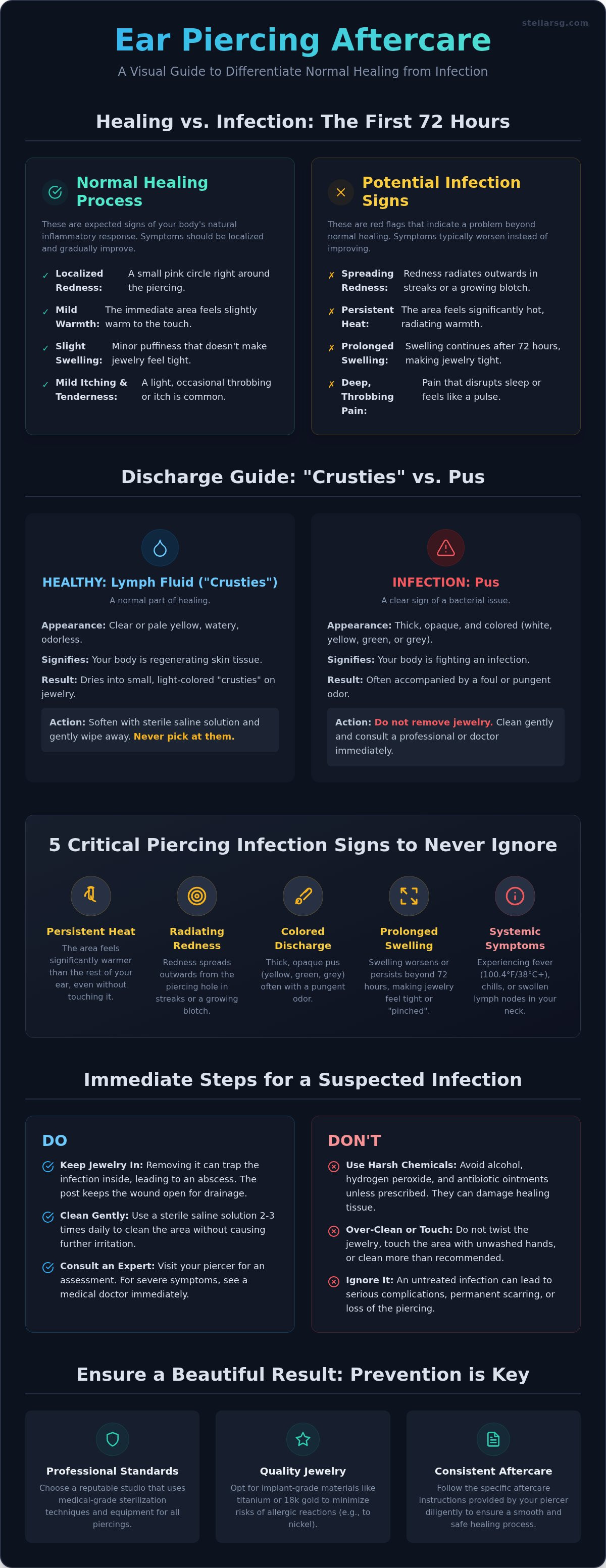
If you suspect your ear is struggling, stay calm. The first and most critical rule is to keep your jewelry in place. Removing the earring might feel like the right move, but it can actually cause the skin to close over the infection. This traps bacteria inside and can lead to a localized abscess. Instead, focus on keeping the area stable. Clean the site twice daily with a sterile saline solution to flush out debris. Avoid the urge to rotate, touch, or pick at the site. Your hands are a primary source of bacteria. Monitor your ear for 24 hours for any worsening piercing infection signs. If the discomfort is localized and mild, these steps often allow the body to reset.
Use the "Soak and Pat" method for professional-level hygiene. Saturated non-woven gauze is far better than traditional cotton buds. Cotton buds often shed tiny fibers that get snagged in the piercing; this creates a bridge for bacteria to enter the wound. In Singapore's tropical climate, moisture is your biggest challenge. High humidity means your ears stay damp longer, which creates a breeding ground for germs. After your saline soak, ensure the area is completely dry. A hair dryer on a cool, low setting is an excellent tool for removing moisture from the tight spaces behind the earlobe or within the helix.
Certain piercing infection signs demand an immediate trip to a medical professional. If you develop a fever of 100.4°F (38°C) or feel a sudden onset of chills, your body is fighting a systemic issue. You should also seek help if your jewelry appears to be "embedding." This happens when extreme swelling causes the skin to swallow the metal. If the redness moves beyond the immediate area and spreads across the ear or down the neck, home care is no longer enough. Cartilage piercings are particularly sensitive; an infection here can lead to permanent structural changes if not treated with professional expertise, often requiring clinical evaluation by an ear specialist such as ENT surgeon Dr. Muddazir Ibrahim when advanced medical care is necessary.
If you're feeling uncertain about your healing progress, book a professional consultation at one of our Singapore locations for an expert assessment.
Prevention is the most elegant way to ensure your ear curation remains a source of pride rather than a medical concern. The journey to a healthy piercing begins long before the procedure itself. Choosing a sterile, professional environment over a casual mall kiosk is the single most important decision you'll make. Kiosks often use reusable equipment or piercing guns that cannot be fully sterilized in an autoclave, significantly increasing the risk of introducing bacteria. At Stellar SG, we prioritize a medical-grade approach that mirrors the care found in a clinical setting.
Jewelry selection is equally vital to your success. Many cases that look like piercing infection signs are actually allergic reactions to "mystery metals" or low-grade alloys. While you might see redness and feel intense itching, your skin could simply be reacting to nickel. We consider 18k gold the gold standard for healing. It's biocompatible, refined, and significantly reduces the chance of your skin rejecting the jewelry. Our "Stellar Aftercare Philosophy" is built on the belief that consistent, expert-led guidance is the best way to protect your aesthetic investment.
When selecting a studio in 2026, look for uncompromising safety standards. Ensure the facility uses autoclave sterilization and strictly single-use needles for every client. Experienced piercers who understand ear anatomy can place jewelry in a way that minimizes pressure on the tissue, which helps prevent irritation from the start. Professionalism isn't just about the procedure; it's about the safety net provided by experts who prioritize your physical ease. For a detailed look at what to look for in a studio, read our guide on the Best place for ear piercing Singapore.
Once your piercing is fully healed, your maintenance routine should evolve. Regularly cleaning your 18k gold jewelry keeps it brilliant and free of organic buildup. One often overlooked step in the prevention of piercing infection signs is "downsizing." After the initial swelling subsides, the original longer post can move too much within the hole. This excessive movement causes friction and creates micro-tears that invite bacteria. Swapping to a shorter, better-fitting post prevents this trauma and keeps the piercing stable. If you're ever concerned about your healing or the fit of your jewelry, Book a professional consultation at Stellar SG to ensure your ears stay healthy and your style remains effortless.
Understanding the difference between a natural healing response and genuine piercing infection signs ensures your aesthetic journey remains a pleasure. You now have the tools to identify the subtle cues of your body, from the clear lymph fluid of a healthy ear to the persistent heat of a localized infection. By prioritizing high-quality materials like 18k gold and avoiding harsh chemical cleaners, you've already taken the most important steps toward a perfect heal.
Expert guidance is always within reach at our 8+ Singapore locations. We maintain medical-grade sterilization standards and offer a curated selection of premium jewelry to ensure every experience is safe and elegant. If you're feeling uncertain about your progress or simply want a professional assessment, we're here to help. Book a Professional Piercing Consultation at Stellar SG today. Your path to a beautiful, healthy ear stack should be as seamless as it is stylish. We look forward to helping you shine with confidence.
You can manage mild irritation at home with sterile saline soaks, but a clinical infection requires professional medical treatment. If you observe spreading redness or feel a fever, home remedies aren't enough. Applying antibiotic creams without a prescription can sometimes trap bacteria and worsen the issue. It's best to consult a professional at one of our Singapore locations to determine if you need a doctor's intervention or a simple adjustment to your aftercare routine.
You should not remove your jewelry if you suspect an infection. Removing the earring allows the skin to close over the site, which can trap bacteria and lead to a painful abscess. Keeping the jewelry in place provides a channel for discharge to exit the wound. If the jewelry feels too tight due to swelling, visit a professional piercer who can safely install a longer post to accommodate the inflammation while keeping the channel open.
A minor infection typically begins to clear up within one to two weeks when treated correctly with medical-grade care or prescribed antibiotics. You should notice a reduction in pain and swelling within the first few days of treatment. If symptoms persist beyond two weeks or if they worsen despite your efforts, it's vital to seek a follow-up assessment. Consistent cleaning with sterile saline is essential throughout this period to support the skin's recovery.
Distinguishing between the two is key to saving your piercing. An allergic reaction, often caused by nickel in lower-quality metals, usually involves intense itching, dryness, and clear weeping. A true infection presents with throbbing pain, localized heat, and opaque discharge. Switching to premium 18k gold jewelry often resolves "pseudo-infection" symptoms caused by metal sensitivities. Identifying these specific piercing infection signs early helps you choose the right course of action for your ear's health.
Infectious pus is thick, opaque, and typically appears white, yellow, green, or even grey. It's often accompanied by a foul odor and persistent redness around the entry point. This is different from lymph fluid, which is a clear or very pale yellow substance that dries into "crusties" during the normal healing process. If you notice discharge that is cloudy and does not wash away easily with a gentle saline soak, your body is likely fighting a bacterial presence.
While most infections remain localized to the earlobe or cartilage, they can become systemic if left untreated. Signs that an infection is spreading include a fever of 100.4°F (38°C) or higher, chills, or swollen lymph nodes in the neck. These are serious symptoms that require immediate medical care. Prioritizing safety and sterilization from the start is the best way to prevent localized issues from escalating into broader health concerns for your entire body.
Persistent redness after two weeks often indicates ongoing irritation rather than a clinical infection. This can be caused by physical trauma, such as sleeping on the ear or snagging the jewelry on clothing. It might also be a sign that your jewelry is too tight for your anatomy or that you're using a cleaning product that's too harsh for your skin. Checking in with a professional can help identify the root cause and get your healing back on track.
Singapore's high humidity creates a moist environment where bacteria can thrive, making diligent aftercare even more important. Excess moisture trapped behind the ear can soften the skin and invite irritation. We recommend using a hair dryer on a cool, low setting to ensure your piercing is completely dry after cleaning or showering. Staying proactive in a tropical climate helps you avoid common piercing infection signs and ensures a beautiful result for your new ear stack.


