 SGD
SGD EUR
EUR
 AUD
AUD
 GBP
GBP
 JPY
JPY
 INR
INR
Total: $0.00
Taxes and shipping calculated at checkout


Last Tuesday, Cheryl found a stunning pair of gold hoops, only to have her ears itching and swollen before her afternoon meeting at Marina Bay Financial Centre even started. It’s a painful reality for many in Singapore where high humidity can often worsen skin reactions to low-quality metals. We agree that searching for earrings for sensitive ears shouldn't mean settling for boring, clinical designs that lack personality. You deserve premium jewellery that feels as sophisticated as it looks, regardless of how sensitive your skin might be.
This 2026 guide will help you decode confusing industry labels and identify which medical-grade materials actually work for your body. You'll discover how to choose beautiful, irritation-free pieces that suit our tropical climate and your unique style. We're going to cover the specific metals you should avoid forever, the best local options for all-day comfort, and why Stellar SG is the trusted choice for elegant, safe adornments in the heart of the city.
It's a common frustration for many jewelry lovers in Singapore. You find a pair of elegant studs, only to experience itching, swelling, or redness within hours of wearing them. This reaction is typically allergic contact dermatitis, a condition where your immune system reacts to specific metal ions that penetrate the skin. While it might seem like a minor annoyance, understanding The Science of Metal Allergies is the first step toward enjoying stylish accessories without the pain. For those with a history of reactions, selecting specialized earrings for sensitive ears is not just a preference; it's a necessity for skin health.
Manufacturers often use nickel as a base metal or a hardening agent because it's inexpensive and durable. However, nickel is the leading cause of jewelry-related allergies globally. You might notice itching, localized redness, or even the weeping of clear fluid from the piercing site. These symptoms signify that your body is fighting off the metal ions. One of the most misunderstood aspects of this allergy is the accumulation effect. You could wear low-quality jewelry for 5 or 10 years without any issues, but once your body reaches its threshold, a permanent sensitivity develops. Once this switch flips, even trace amounts of nickel will trigger a reaction every time you wear non-hypoallergenic pieces.
Singapore’s tropical climate plays a significant role in how your skin interacts with jewelry. With an average daily humidity level of 84%, moisture is constantly present on the skin's surface. This humidity causes low-quality plating to degrade faster, exposing the reactive base metals underneath. Many local markets sell "stainless steel" options, but these aren't always surgical-grade 316L or titanium. Lower grades of steel often contain significant nickel content that leaches out when the metal's protective layer is compromised.
Sweat acts as a potent chemical catalyst that speeds up the release of irritating metal ions directly into the earlobe. This accelerated leaching explains why a pair of earrings might feel fine in a dry, air-conditioned office but cause immediate discomfort during a walk through the Botanic Gardens. To ensure your comfort, it's vital to choose premium materials that remain stable in high heat and moisture. If you are concerned about a recent reaction or want to start your jewelry journey safely, our piercing service focuses on using only the safest, most biocompatible materials to prevent these issues before they start.
Distinguishing between a temporary irritation and a long-term allergy is key. Irritation might come from a heavy design or a sharp post, while a true allergy persists and worsens with repeated exposure. Investing in high-quality earrings for sensitive ears ensures you can maintain your style without compromising on comfort or safety.
For those interested in exploring a wider variety of chic and budget-friendly accessories online, you can visit Frenelle Jewellery to find pieces that help you express your personal style.
Choosing the right metal isn't just about the shine; it's about how your skin responds to what's hidden inside the alloy. For those seeking earrings for sensitive ears, the material choice determines whether you'll enjoy your jewelry or suffer through a week of irritation. Metals rank differently on the biocompatibility scale. At the bottom, you'll find "mystery metals" found in fast-fashion boutiques. At the top, titanium and 14K+ gold reign supreme for their non-reactive properties.
Sterling silver is a classic choice, but it's rarely pure. Standard 925 sterling silver contains 92.5% silver and 7.5% other metals, often copper or nickel. This alloy mix is why many Singaporeans still experience Nickel Allergy Symptoms and Prevention needs even when wearing silver. If your skin turns green or itchy, the silver isn't the culprit; it's the hidden additives. For a truly safe experience, 24K gold plating over surgical steel is a game-changer. It provides a thick, non-reactive barrier of pure gold while maintaining the structural integrity and safety of the steel base.
316L Surgical Steel is the reliable workhorse of the jewelry world. It's durable, resists corrosion, and is designed to keep nickel trapped within the metal so it doesn't leach into your skin. For those with extreme sensitivities, titanium is the 100% nickel-free alternative. It's incredibly lightweight and often used in medical implants because the body doesn't reject it. Choosing these materials is vital for new ear piercings to ensure the healing channel remains calm and healthy. Always look for "Implant Grade" labels, as these meet higher ASTM standards than standard decorative metals.
Pure gold is too soft for daily wear, so it's blended with alloys. 18K gold contains 75% pure gold, making it significantly safer for sensitive skin than 10K or 14K options which have higher base-metal content. If you love the warm glow of copper-toned jewelry, be cautious. The copper content in rose gold earrings in Singapore can occasionally cause reactions for those with specific metal sensitivities. A 24K gold-plated finish acts as a premium shield, offering the look of solid gold with the hypoallergenic security of a medical-grade core. It's an elegant way to maintain your style without compromising on comfort.
Ready to upgrade your collection? You can explore our professional piercing services to find the perfect, skin-safe match for your aesthetic.
Choosing jewelry shouldn't be a trade-off between health and high fashion. The "Stellar Sensitive" philosophy bridges this gap by ensuring every piece meets rigorous medical safety standards while reflecting modern elegance. In 2026, the focus has shifted toward lightweight, biocompatible materials that don't compromise on visual impact. Weight is a primary concern for anyone with reactive skin or slightly stretched lobes. Heavy alloys often pull on the piercing site, creating micro-tears that invite bacteria and irritation. By prioritizing titanium and medical-grade steel, you can enjoy substantial designs that feel weightless throughout the day.
Transitioning from your initial piercing studs to fashion jewelry is a delicate phase. Most professional piercers in Singapore recommend waiting 6 to 12 weeks for lobe piercings and up to 12 months for cartilage before switching. When you're ready to make the change, it's vital to choose earrings for sensitive ears that mirror the quality of your starter studs. If you're unsure about the healing progress of your piercing, you can book an appointment for a professional assessment at one of our studios.
For those with highly reactive skin, stud earrings remain the gold standard. They minimize movement within the piercing hole, which reduces the risk of friction-induced inflammation. Our 2026 collection focuses on smooth backings and secure clutches designed to prevent skin pinching, a common issue with lower-quality butterfly backs. Huggie hoops have also become a staple for the active Singaporean lifestyle. These "set and forget" pieces sit close to the lobe, making them ideal for gym sessions or humid commutes where dangling jewelry might snag or cause discomfort. Look for clicker closures that provide a flush, seamless finish against the skin.
You don't have to skip the drama just because your skin is finicky. Large hoops are achievable when they're crafted from hollowed surgical steel or high-purity titanium. This construction provides the bold look of "heavy metal" without the actual physical strain. For special occasions, drop earrings featuring surgical steel hooks offer a sophisticated silhouette that won't leave your ears red or itchy by the end of the night. A smart style tip for 2026 is mixing metals safely. You can achieve a multi-tonal look by ensuring every piece in your stack uses a consistent hypoallergenic base. This allows you to blend gold and silver aesthetics while maintaining a unified safety standard for your earrings for sensitive ears.
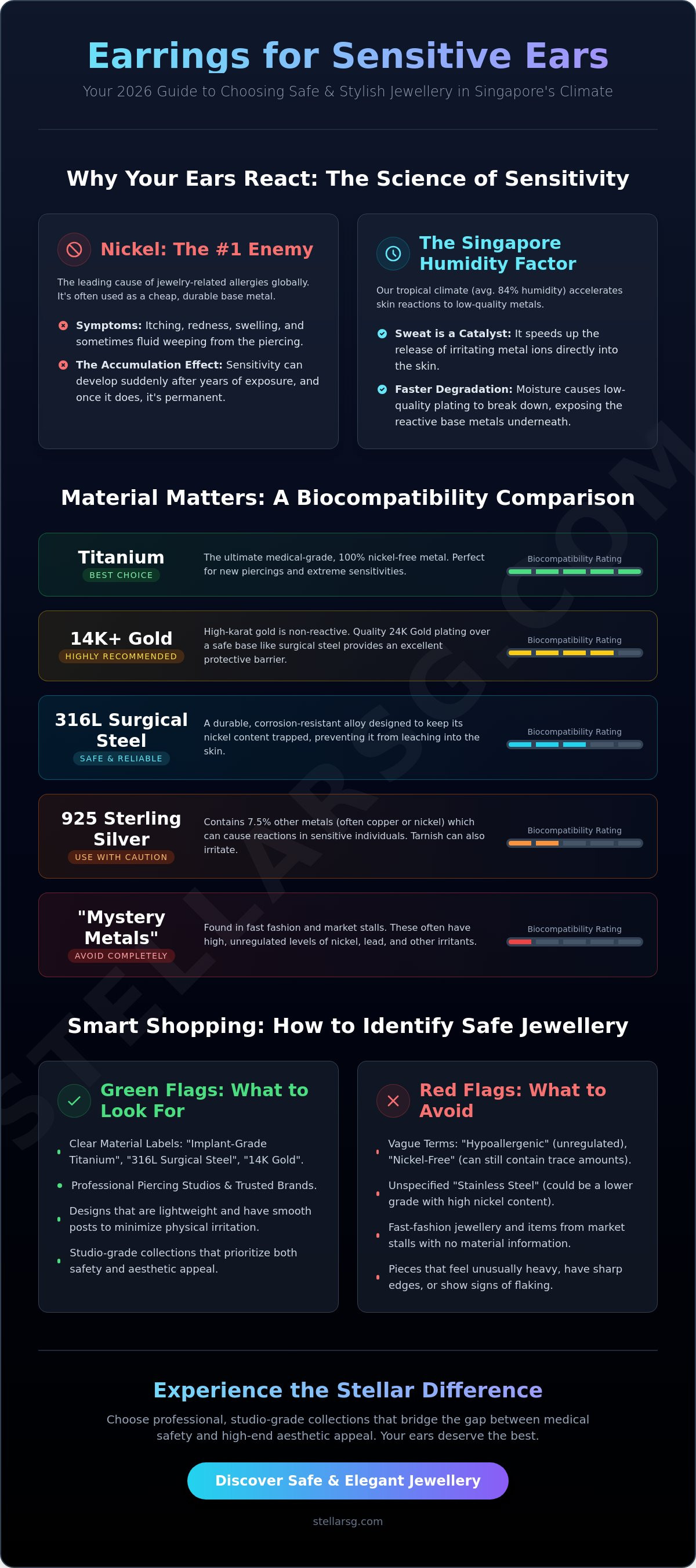
Finding the right earrings for sensitive ears in Singapore requires a sharp eye and a bit of skepticism. Local markets and pop-up stalls often feature trendy pieces for under S$10, but these frequently hide high levels of nickel or lead beneath a thin, temporary coating. Don't rely on generic "hypoallergenic" stickers. In 2026, reputable brands provide specific material certifications, such as ASTM F-136 titanium or 316LVM surgical steel, rather than vague marketing terms.
The "Magnet Test" is a common myth you'll encounter in shopping guides. Many shoppers believe a magnet helps identify pure gold or silver, but it's not a reliable safety test for your skin. High-quality 316L stainless steel is often non-magnetic, while some lower-grade alloys might also pass the test without being safe for reactive skin. Instead of carrying a magnet, trust a hallmark or a verified certificate of origin from the retailer.
Don't ignore the butterfly or the backing. A premium titanium stud is useless if the backing is made of cheap plated brass. This component sits directly against the back of your ear, often trapping moisture and sweat. Ensure every component touching your skin meets the same safety standard to prevent localized irritation.
Choose brands that share exactly where their metals come from. Specialist ear piercing only studios often provide better jewellery quality because their reputation depends on successful healing and long-term skin health. Premium brands adhere to the 'Nickel Release' standard, which measures the specific amount of nickel a piece of jewellery sheds onto the skin over time rather than just its presence in the alloy. This scientific approach ensures your earrings for sensitive ears remain safe even after years of wear.
Singapore's 80% average humidity can accelerate oxidation and trap debris. Store your pieces in airtight pouches to keep them pristine and dry. Clean your earrings weekly with a mild, fragrance-free soap or a specialized saline solution to remove sebum and bacteria that mimic metal allergies. If you notice a copper-colored tint or "peeling" on your studs, the plating has worn thin. Replace them immediately to avoid an adverse reaction. Regular inspections every six months help maintain both the style and the safety of your collection.
Ready to upgrade your collection with pieces that prioritize your comfort? Book your appointment for a professional consultation and find your next pair of safe, elegant studs.
Choosing the right earrings for sensitive ears is more than a fashion choice; it's a commitment to your long-term skin health. At Stellar, we bridge the gap between high-end aesthetics and medical safety with our Stellar Sensitive collection. Every piece is proudly made in the USA and curated specifically for the Singapore market. While generic retailers often prioritize volume, our focus remains on the integrity of the materials that touch your skin. We select only biocompatible metals that resist corrosion and minimize the risk of allergic reactions, ensuring your style never comes at the cost of comfort.
The Stellar difference lies in our dual identity as both a premium jeweler and a professional piercing studio. This expertise allows us to understand the biology of a piercing better than a standard department store. Our commitment to safety is evident in every step of our process:
A professional piercing service is the foundation of healthy ears. Many issues attributed to "sensitive skin" actually stem from improper piercing techniques or low-quality initial jewelry. At Stellar, we use specialized medical-grade piercing studs designed to facilitate airflow and rapid healing. Our staff provides expert aftercare advice specifically tailored to the Singapore lifestyle. We understand how local factors like high humidity and daily exercise can impact your healing process. Since our establishment, we've helped over 15,000 clients achieve irritation-free results through our precise, gentle approach.
You can find our elegant studios conveniently located in Singapore's premier shopping destinations, including ION Orchard, Vivocity, and JEM. Our consultants don't just show you products; they help you analyze your skin's needs. If you've struggled with earrings for sensitive ears in the past, our team can identify the right alloys to keep your skin calm. We've designed our boutiques to be welcoming spaces where safety and luxury coexist. Whether you're looking for a sophisticated new look or a safe first piercing for your child, we're here to guide you. Book your appointment at a Stellar studio today and discover the confidence that comes with premium, irritation-free jewelry.
Choosing the right earrings for sensitive ears in Singapore no longer requires a choice between fashion and skin health. By 2026, the move toward medical-grade materials has redefined the local jewellery landscape. Prioritizing biocompatible metals like those in our specialized Stellar Sensitive collection, which is manufactured in the USA, ensures your piercings remain calm even in our humid tropical climate. Our expert staff at ION Orchard, JEM, and Vivocity are dedicated to this fusion of safety and sophistication, offering personalized styling that respects your body's needs.
You deserve a piercing experience that's as seamless as it is beautiful. Our three dedicated studios across Singapore provide a professional environment where safety meets high-end curation. From the initial consultation to selecting your final piece, we focus on providing a premium experience that eliminates the guesswork of hypoallergenic shopping. Don't let past sensitivities hold you back from expressing your style with confidence and ease.
Book your professional piercing appointment or browse our Stellar Sensitive collection today!
We look forward to helping you discover your most comfortable and stylish look yet.
You should be cautious with sterling silver if you have highly sensitive ears. While it contains 92.5% pure silver, the remaining 7.5% is typically copper or nickel. These alloys cause skin reactions in approximately 18% of the population according to clinical dermatology reports. If you love the silver look, choose rhodium-plated options for a protective, premium barrier against irritation.
Medical-grade titanium is the safest choice for a new ear piercing in Singapore. It's a biocompatible metal used in surgical implants, so it won't react with your body's tissues during the healing phase. Our skilled staff recommends titanium or 14k solid gold to ensure a safe, elegant experience. These materials help you avoid the common infections associated with lower-quality metals.
No, these terms have different meanings in the jewelry industry. Hypoallergenic means a product is less likely to cause a reaction, but it isn't a strictly regulated medical claim. Nickel-free specifically means the metal doesn't contain nickel, which is the leading cause of contact dermatitis. Always check for nickel-free labels when shopping for earrings for sensitive ears to ensure maximum comfort.
Your ears likely itch because the gold is a lower karat or uses a reactive alloy. 9k or 10k gold contains a higher percentage of base metals like copper or nickel to increase durability. Even 18k white gold is often alloyed with nickel for its bright color. Switching to 14k or 18k yellow gold usually solves this problem because these have higher purity levels.
Yes, you can develop a metal sensitivity at any stage of adulthood. Contact dermatitis often occurs after years of repeated exposure to specific allergens found in costume jewelry. Recent studies indicate that skin barriers can weaken over time, making you more susceptible to irritants you once tolerated. If your old favorites now cause redness, it's time to invest in premium, biocompatible pieces.
Clean your earrings twice a week using warm water and a mild, fragrance-free soap. Avoid harsh chemical cleaners or rubbing alcohol, as these can dry out your skin and lead to micro-tears. Gently pat your jewelry dry with a clean microfiber cloth before wearing. Regular maintenance prevents the buildup of bacteria and dead skin cells on your earrings for sensitive ears.
Titanium is the superior option for anyone with high metal sensitivity. While surgical steel is durable, most grades like 316L still contain 8% to 12% nickel. Titanium is 100% nickel-free and highly resistant to corrosion from sweat or salt water. It provides a lightweight, stylish, and completely safe alternative for daily wear in Singapore's humid climate.


